
Introduction
AI SEO keywords strategy is changing how businesses research and use keywords in 2026. It is no longer about stuffing content with high-volume search terms. As artificial intelligence tools like ChatGPT, Perplexity, and Google’s AI Overviews reshape how users discover information, keyword research has become more focused on search intent, conversational queries, and context-rich content.
Traditional SEO focused heavily on ranking for exact-match keywords, but AI-driven search now favors content that clearly answers questions and provides useful, relevant information. Marketers who fail to adapt risk losing visibility to AI-generated answers that satisfy users before they ever visit a website.
In this guide, you will learn the most effective AI SEO keywords strategy for 2026, including how to optimize for generative engine visibility (GEO), target long-tail conversational keywords, and structure your content so both AI systems and traditional search engines can understand and rank it effectively. Let’s dive in.
The Shift from Traditional SEO to AI Search Optimization
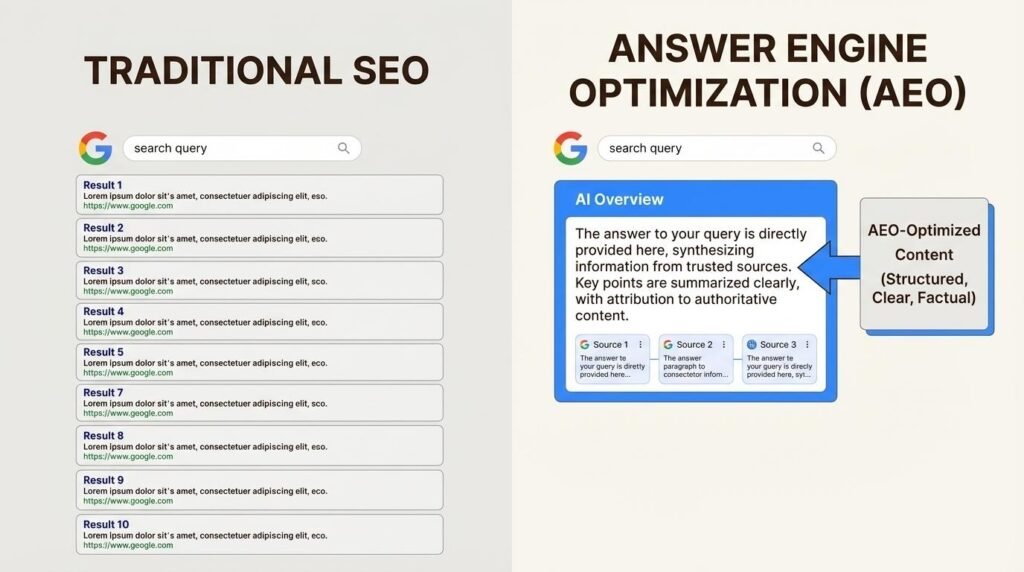
Search is undergoing a major transformation, and by AI SEO keyword strategy 2026, success will no longer depend on ranking positions alone. Instead, visibility within AI-generated answers and citations will define SEO performance. The best keywords strategy for AI SEO 2026 focuses on semantic clarity, contextual depth, and content extractability rather than simple keyword usage.
This shift also changes how performance is measured. Traditional metrics like clicks and rankings are becoming less relevant, while new indicators such as citation frequency, share of model, and AI-driven traffic are gaining importance. For instance, Adobe research highlights that generative AI referrals increased more than 10x in the United States between July 2024 and February 2025.
AI search optimization improves content visibility across AI platforms like LLMs and assistants. Unlike traditional SEO, it prioritizes structure, credibility, and relevance, as AI systems extract and generate answers based on context, not just rankings.
The Zero-Click Reality and AI Overviews
More than half of Google searches now end without anyone clicking through to a website . AI Overviews appear for nearly one in five searches, fundamentally changing user behavior. For example, simple factual queries that AI can answer directly will not drive website traffic anymore. However, transactional and commercial intent keywords still drive clicks because AI cannot complete complex buying decisions for people.
Therefore, your AI SEO keyword strategy must balance quick wins with strategic targets. You need to target keywords where users are looking for nuanced expertise, recent developments, or multiple perspectives. In addition, you should optimize to be the cited source in platforms like ChatGPT, Perplexity, and Google AI Overviews .
Informational keywords that ask simple questions, such as “What is Drupal?” or “How many websites exist?” will not drive traffic because AI answers them directly in the overview. On the other hand, commercial keywords like “hire drupal developer” or “best website platform” still drive traffic because users need to evaluate options before making a decision. Similarly, complex research queries that require nuanced expertise, recent developments, or multiple perspectives send people to authoritative sources rather than relying solely on AI summaries.
Traditional SEO vs. AI Optimization (AEO/GEO)
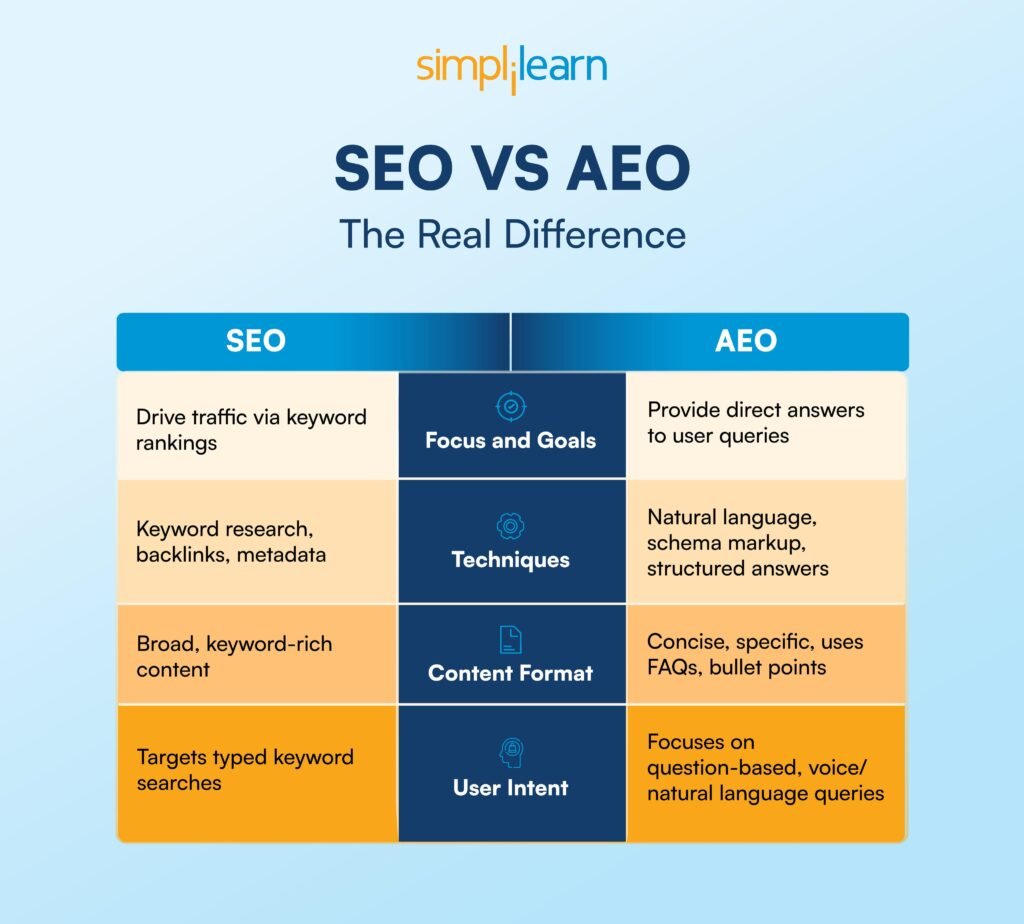
To understandAI SEO keyword strategy SEO keyword strategy for AI SEO 2026, it is essential to recognize how AI optimization differs from traditional SEO. The following comparison highlights the key differences between both approaches.
| Dimension | Traditional SEO | AI Optimization (AEO / GEO) |
| Primary Goal | Rank higher in SERPs | Be cited in AI-generated answers |
| Success Metric | Rankings, clicks, sessions | Citation frequency, AI visibility |
| Search Interface | List of ranked blue links | Synthesized answers |
| Content Focus | Keywords and backlinks | Extractable facts, clarity |
| Optimization Strategy | Page relevance and link equity | Extractability and verifiability |
| User Interaction | User selects a link | User receives summarized answers |
| Analytics Focus | Traffic volume and position | Citation tracking and AI referral |
In traditional SEO, the primary goal was to rank higher in Search Engine Results Pages (SERPs), and success was measured through rankings, clicks, and organic sessions. The search interface presented users with a list of ranked blue links, and the content focus was on keyword targeting and backlink authority. The optimization strategy revolved around improving page relevance and link equity, while analytics focused on traffic volume and position tracking.In contrast, AI Optimization (AEO/GEO) has a completely different primary goal: to be cited and accurately represented in AI-generated answers. Success is now measured through citation frequency, share of model, and AI visibility. The search interface delivers synthesized answers and conversational responses instead of blue links. Content must prioritize extractable facts, structured clarity, and contextual completeness. The optimization AI SEO keyword strategy focuses on improving extractability, verifiability, and contextual clarity, while analytics center on citation tracking, AI referral traffic, and answer inclusion monitoring.
5-Phase Framework for AI Keyword Research
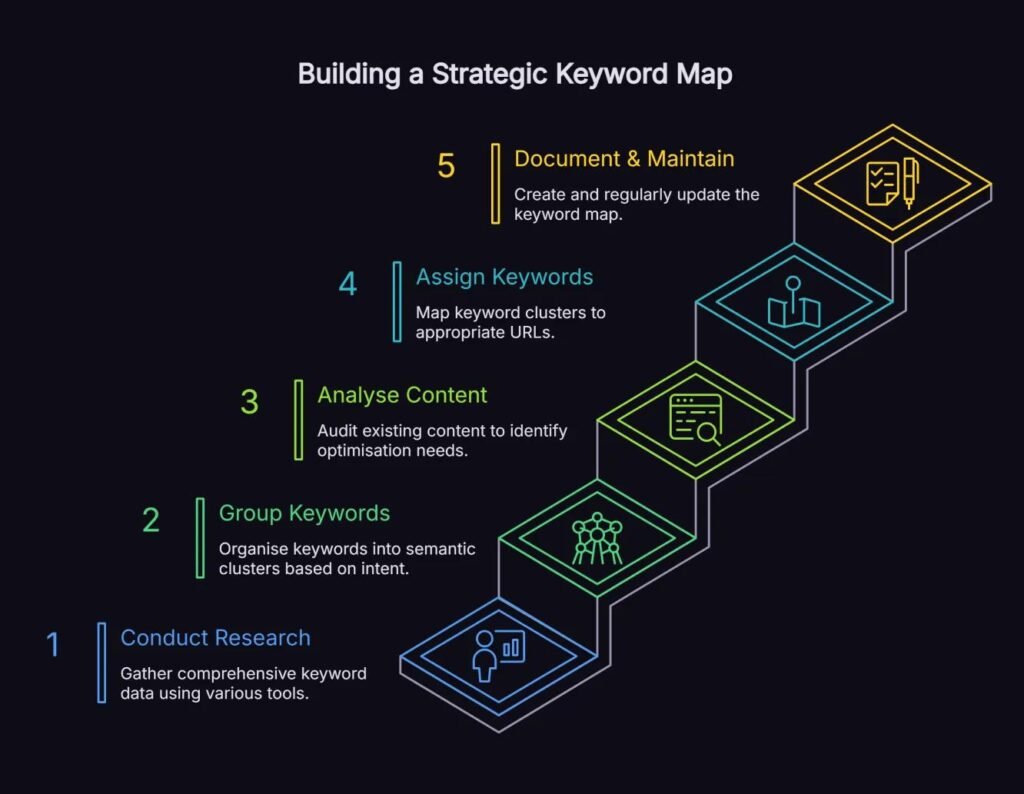
Creating the best keywords strategy for AI SEO 2026 requires a structured approach. Here is a practical 5-phase framework to discover, analyze, and organize keywords effectively.
Best Keywords Strategy for AI SEO 2025: Discovery and Zero Search Volume (ZSV)
Traditional keyword tools rely on historical database lookups. However, an estimated 15% of daily searches are brand new queries with zero historical data . Chasing Monthly Search Volume (MSV) means missing the Zero Search Volume (ZSV) long-tail opportunities that drive real results.
Therefore, the most effective AI SEO keyword strategy targets queries from customer support logs, niche Reddit threads, and related questions from AI platforms. Furthermore, you should use AI tools like ChatGPT, Claude, and specialized SEO platforms to generate keyword variations for topics with no search history. These tools understand semantic relationships and can identify patterns across languages and industries.
For keyword discovery, several free and affordable tools can expand your keyword list effectively. Google Search Console shows which keywords currently drive traffic to your site and reveals existing ranking opportunities through regex filters for Page 2 queries. Google Keyword Planner provides free access to monthly search volume estimates. Meanwhile, platforms like Reddit and SparkToro help you discover ZSV opportunities by finding niche community questions that competitors overlook.
Phase 2: Semantic Clustering and Intent Mapping for AI SEO Keyword Strategy
Semantic clustering groups keywords by meaning and user intent rather than just word similarity. For instance, AI understands that “best running shoes” and “top sneakers for jogging” target similar intent, even with no shared words. This semantic understanding enables you to build comprehensive topic coverage that signals expertise to search engines and serves users at every stage of their journey.
Additionally, search intent is the “why” behind a query. AI excels at intent classification because it understands the linguistic patterns that signal user goals. You must align each piece of content with the right intent. Informational intent keywords are learning and research queries, typically containing signals like “how to,” “what is,” or “why does.” For these, you should create blog posts, guides, tutorials, and explainer videos.
Commercial intent keywords indicate research before purchase, with signals like “best,” “top,” “review,” or “comparison.” For these, you should produce comparison posts, listicles, reviews, and buying guides. Transactional intent keywords show the user is ready to take action, featuring signals like “buy,” “pricing,” “discount,” or “sign up.” For these, create landing pages, pricing pages, and signup flows.
Phase 3: Competitive Gap Analysis in AI SEO Keyword Strategy 2025
AI-powered competitive gap analysis reveals keywords where your competitors rank but you do not. While traditional tools like Ahrefs and SEMrush identify these gaps through data comparison, AI adds a layer of strategic analysis. It helps understand why certain gaps matter more than others and groups gaps by topic theme.
Meanwhile, you should use Google Search Console regex filters to find Page 2 queries you already rank for but have no dedicated page for. These are high-probability wins because search engines already consider you relevant for the topic. Furthermore, analyzing your competitors’ content gaps allows you to create more comprehensive resources that outperform existing content.
When comparing AI SEO tools, several options stand out in 2026. Ahrefs excels at competitive gap analysis and offers an AI Search Intents metric starting from $99/month. Semrush provides robust keyword research and tracking with its Keyword Magic Tool powered by AI, starting from $129/month. Surfer SEO focuses on content optimization and generates Topical Maps based on entity relationships, starting from $89/month
Phase 4: Building Topic Clusters
Topic clusters organize your content around pillar pages and cluster content. This architecture signals topical authority to search engines and creates clear user pathways through your content. Pillar pages should be comprehensive guides of 3,000 words or more that cover broad topics, while cluster content should be specific articles of 1,000 to 2,000 words that dive deep into subtopics.
For example, if you are targeting a broad topic like “website redesign,” you should also target “website redesign checklist,” “website redesign cost,” and “website redesign timeline” as cluster content supporting a main pillar page. Consequently, every cluster article links to its pillar, and pillars link to all cluster content. This internal linking strategy helps AI systems and search engines understand your content hierarchy.
The Semantic Cocoon Strategy takes this further by creating hermetic topic ecosystems. In this approach, authority pages link down to cluster pages, cluster pages link up to the pillar or across to sibling articles, and they never link out to random unrelated topics. This creates a closed semantic environment that signals deep topical authority to both search engines and AI systems. Supporting content fills any remaining semantic gaps by linking to both the cluster article and the pillar page.
Phase 5: The Golden Answer Format
To optimize for the best keywords strategy for AI SEO 2026, you must adapt your content structure for AI extraction. The most effective method is the “Golden Answer” format: a direct, concise answer of approximately 40 words immediately after your H2 headings.
Because generative AI systems retrieve content in modular “chunks” rather than entire pages, if a section depends on surrounding paragraphs for context, it risks misinterpretation. Therefore, headings must signal intent explicitly, and definitions should be concise and self-contained. Additionally, structured data such as Schema markup and FAQ formatting enables AI systems to identify contextual units with greater accuracy. This improves both traditional indexing and LLM optimization simultaneously.
Best Keywords Strategy for AI SEO 2026: Variations and Synonyms
When implementing the best keywords strategy for AI SEO 2026, it is vital to use variations and synonyms naturally to avoid keyword stuffing while maintaining a high readability score. The ideal keyword density should remain between 1% and 1.5%.
Instead of repeating the exact phrase, utilize synonyms such as “optimal keyword tactics for artificial intelligence search,” “top SEO terms strategy for AI in 2026,” “effective AI search engine optimization keywords,” “AI-powered keyword planning for search engines,” and “semantic keyword approach for generative AI.” Moreover, structured data enhances extractability. Schema markup and FAQ formatting sections enable AI systems to identify contextual units with greater accuracy. This improves both traditional indexing and LLM optimization.
Content Freshness and E-E-A-T Signals
Content freshness plays a critical role in AI search optimization. LLMs weigh authority signals and domain credibility when synthesizing answers. Experience, Expertise, Authoritativeness, and Trustworthiness (E-E-A-T) are not just SEO considerations; they are AI inclusion criteria . Outdated specifications or unclear claims increase the risk of hallucination or competitor substitution.
Experience refers to first-hand knowledge of the topic, which you can demonstrate by including author bios with relevant professional experience. Expertise involves deep subject matter knowledge, best shown by citing credentials, certifications, and real case studies. Authoritativeness reflects industry recognition and reputation, which you build by earning backlinks from authoritative domains. Trustworthiness represents the accuracy and reliability of your information, achieved by using verifiable data, clear sourcing, and secure HTTPS protocols.
Furthermore, as voice and visual AI queries grow, optimization must extend beyond text. Natural language phrasing supports conversational search. Updated alt text and descriptive image metadata support AI-driven visual discovery. These adjustments do not replace traditional SEO fundamentals; they extend them into a synthesis-first environment.
Common Mistakes to Avoid
Even smart marketers make mistakes that weaken their keyword strategies. Here are some common pitfalls to avoid when using the best keywords strategy for AI SEO 2026.
Keyword cannibalization happens when multiple pages target the same keyword. This confuses search engines about which page should rank.
To fix this, either combine similar content into one strong page or clearly separate keywords for each page.
For example, “Drupal development” and “Drupal development services” are too similar and compete with each other. A better approach is to target “Drupal development” and “Drupal migration services” separately.
Chasing search volume over intent is another mistake. High-volume keywords often bring low conversions.
Instead, focus on user intent and problem-solving content. A keyword with 100 targeted searches is better than one with 10,000 irrelevant searches.
The Rise of Agentic Traffic & AI SEO Keyword Strategy
A deeper transformation is underway: the rise of agentic traffic. AI agents such as GPTBot and PerplexityBot do not simply crawl and index. In addition to extracting and comparing claims, they perform tasks on behalf of users. These agents increasingly shape decision-making before a human visitor interacts directly with your site .
On one hand, AI-generated answers can position your brand as authoritative early in the buying process. On the other hand, traditional analytics tools often classify this activity as “Direct” traffic or fail to capture it entirely. If AI agents are crawling your documentation and influencing decisions without visibility into that interaction, optimization becomes guesswork.
Therefore, the strategic risk is even more significant. If an LLM cannot parse your product specifications accurately and instead hallucinates incomplete or outdated information, the customer may form a decision before ever reaching your digital properties. This is why AI SEO must be treated as infrastructure, not experimentation.
Conclusion

In conclusion, the best keywords strategy for AI SEO 2026 requires a fundamental shift from focusing solely on rankings to prioritizing citations and AI-generated visibility. By understanding the zero-click reality, utilizing semantic clustering, implementing the Golden Answer format, and building robust topic clusters, businesses can adapt to the new AI search landscape. Ultimately, the goal is no longer to rank higher it is to become the answer that AI systems synthesize for users.Moreover, this strategy demands continuous monitoring of citation frequency, AI referral traffic, and answer inclusion rates. Teams that embrace these changes early will gain a significant competitive advantage as AI continues to reshape how people discover and evaluate information online.