
Introduction
The real estate industry has always been about one thing: timing. For decades, the “dream home” was something you found in a Sunday newspaper or by driving through neighborhoods looking for “For Sale” signs.
Then came the internet, and suddenly, thousands of listings were at our fingertips. But even with all that data, the process remained exhausting.
Buyers were left scrolling through endless pages, while agents were buried under a mountain of repetitive questions.
Enter the era of AI. If you’ve looked for a home recently, you’ve likely encountered a small bubble in the corner of your screen.
That’s not just a basic script anymore; it’s a sophisticated AI chatbot. These digital assistants are no longer just “nice-to-have” features they are fundamentally changing how people find homes and how businesses talk to their customers.
In this article, we’ll explore how AI chatbots in real estate are revolutionizing property discovery AI and taking real estate buyer engagement to a whole new level.
What Are AI Chatbots in Real Estate
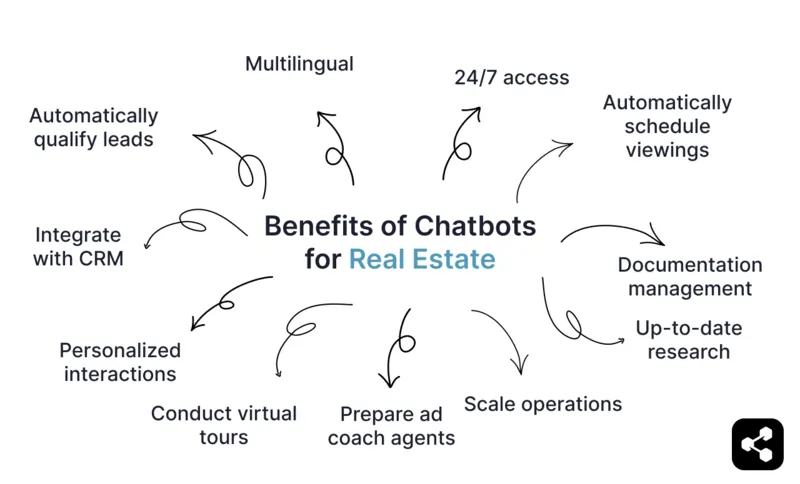
To understand the shift, we first need to define what these bots actually are. Unlike the clunky, “press 1 for sales” bots of the past, modern AI chatbots are powered by Large Language Models (LLMs) and Natural Language Processing (NLP). They don’t just follow a flowchart; they understand context, intent, and even the emotional nuances of a conversation.In the world of real estate, an AI chatbot acts as a 24/7 digital concierge. It lives on a realtor’s website, Facebook page, or even WhatsApp. Its job is to greet visitors, answer questions about specific listings, and even help users narrow down their search based on their lifestyle—not just their budget.Think of it as a bridge between a static website and a human agent. While a website just sits there, a chatbot engages. It asks, “Are you looking for a backyard for a dog?” or “Is proximity to the subway a dealbreaker?” By doing this, it turns a passive search into an active conversation. This is the core of AI in real estate marketing moving from broadcasting information to having a personalized dialogue.The technology has evolved to a point where these bots can handle complex multi-turn conversations. They can remember that a user mentioned a “home office” three questions ago and ensure that every property they suggest has a suitable workspace. This isn’t just automation; it’s digital empathy. It’s about making the user feel like they are being heard, even when a human agent is fast asleep.
How AI Chatbots Improve Property Discovery

The biggest hurdle for any homebuyer is the “search fatigue.” Sifting through 500 listings to find the three that actually matter is a full-time job. This is where property discovery AI shines. It acts as a filter that is both more powerful and more intuitive than any traditional search bar.
Hyper-Personalized Recommendations
Instead of a user manually applying filters (3 beds, 2 baths, $500k), a chatbot can handle complex queries. A user might type, “I need a quiet place with good natural light and a home office.” The AI understands these nuances. It scans the database for keywords in property descriptions that match the “vibe” the buyer is looking for, delivering a curated list that feels hand-picked by a friend.Traditional filters are binary either a house has a pool or it doesn’t. But AI can understand “proximity to nature” or “historic charm.” By analyzing thousands of property descriptions, photos, and even neighborhood reviews, the AI can find matches that a simple filter would miss. This reduces the time spent searching and increases the quality of the results.
Instant Data Retrieval
In a hot market, information is currency. If a buyer wants to know if a house has a finished basement or what the HOA Homeowner_association fees are at 11:00 PM on a Saturday, they don’t want to wait until Monday morning for an email. AI chatbots have instant access to the MLS (Multiple Listing Service) and internal databases. They provide answers in seconds, keeping the buyer’s momentum going.This instant access extends beyond just the property itself. Chatbots can pull in data about local school districts, recent sales in the area, and even projected property tax increases. This level of transparency builds immediate trust with the buyer. They feel empowered with data, and that empowerment leads to faster decision-making.
Visual and Interactive Discovery
Modern bots are integrating with virtual tours and high-res galleries. A chatbot can say, “Would you like to see the 3D walkthrough of the kitchen?” and immediately serve the link. This interactive layer makes property discovery feel less like a chore and more like an experience.Furthermore, some advanced bots can now “describe” images to users. If a buyer asks, “Does the kitchen have an island?” the AI can analyze the listing photos in real-time and confirm, “Yes, it has a large granite island with seating for four.” This bridges the gap between seeing a photo and understanding the space
How Chatbots Enhance Buyer Engagement

Engagement is the “holy grail” of real estate marketing. It’s one thing to get someone to visit your site; it’s another to get them to stay and eventually book a viewing. Real estate buyer engagement has traditionally been a slow, manual process. AI has flipped the script
The “Golden Minute” Response
Studies show that if you don’t respond to a lead within five minutes, your chances of converting them drop by 80%. Human agents can’t be everywhere at once. AI chatbots can. By providing an instant response, they capture the lead at the peak of their interest. This immediate gratification builds trust and keeps the user from jumping to a competitor’s site.In a world of instant gratification, waiting for a callback is the fastest way to lose a client. The chatbot ensures that every single person who expresses interest is acknowledged immediately. Even if the bot eventually has to hand the conversation over to a human, the initial engagement has already secured the lead.
Lead Qualification Without the Friction
Not every visitor is ready to buy. Some are just “Zillow surfing A chatbot can gently qualify leads by asking a few strategic questions: “Are you pre-approved for a mortgage?” or “When are you looking to move?” By the time the lead is passed to a human agent, they are “warm,” and the agent has all the context they need to close the deal.This qualification process is also much less intimidating for the buyer. Many people feel pressured when talking to a salesperson too early in the process. A chatbot provides a “safe” space to ask basic questions without feeling like they are being “sold” to. This actually encourages more honest communication, leading to better lead data.
Nurturing the Relationship
Engagement doesn’t end after the first chat. AI bots can remember past interactions. If a user returns to the site a week later, the bot can say, “Welcome back! Are you still interested in homes in the West End, or should we look at that new listing in Oak Ridge?” This level of personalization makes the buyer feel seen and valued. Beyond the website, chatbots can use automated follow-ups via SMS or email. “Hey Sarah, a new 3-bedroom house just hit the market in the neighborhood you liked. Want to see the photos?” This proactive engagement keeps the brokerage top-of-mind throughout the long journey of buying a home.
Key Benefits for Real Estate Businesses
While the benefits for the buyer are clear, the impact on the business side is equally transformative. Implementing AI in real estate marketing isn’t just a tech upgrade; it’s a strategic move for the bottom line.
| Benefit | Impact on Business |
| 24/7 Availability | Captures leads in different time zones and after-hours, ensuring no opportunity is missed. |
| Cost Efficiency | Reduces the need for large customer support teams to handle basic inquiries. |
| Data Insights | Collects valuable data on what buyers are actually looking for, informing future marketing strategies. |
| Scalability | A single bot can handle thousands of conversations simultaneously without breaking a sweat. |
| Improved ROI | By qualifying leads, agents spend their time on high-value tasks, leading to more closings. |
Beyond the table, there’s the benefit of brand consistency. A chatbot never has a “bad day.” It never forgets to mention a key selling point, and it always remains professional and polite. For a large firm, this ensures that every potential client gets the same high-quality first impression, regardless of when or where they reach out.
Real-Life Use Cases and Practical Insights
It’s easy to talk about theory, but how is this working in the real world? Let’s look at some practical applications that are moving the needle today.
Case Study: The Suburban Brokerage
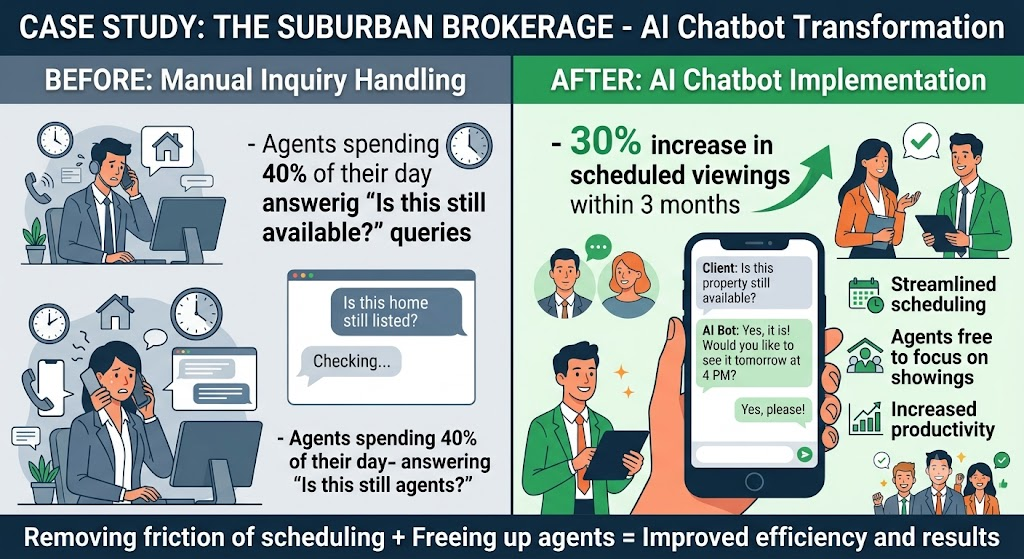
A mid-sized brokerage in a competitive suburb implemented an AI chatbot to handle their “Is this still available?” queries. Before the bot, agents were spending 40% of their day answering these basic questions. Within three months of implementation, they saw a 30% increase in scheduled viewings. Why? Because the bot didn’t just say “Yes,” it followed up with, “Would you like to see it tomorrow at 4 PM?” It removed the friction of scheduling and freed up agents to focus on the actual showings.
Case Study: The Urban Developer
A developer of luxury condos used an AI chatbot to manage inquiries for a new building. The bot was trained on the building’s amenities, floor plans, and local neighborhood highlights. It could answer specific questions like, “What is the pet policy for the rooftop garden?” or “Are there EV charging stations in the garage?” The bot handled over 2,000 inquiries in the first month, qualifying 150 high-intent buyers for the sales team.
chatgpt
Challenges and Limitations
No technology is perfect, and AI in real estate is no exception. It’s important to be realistic about what these tools can and cannot do.
- The Human Touch: Real estate is an emotional business. A chatbot can find you a house with three bedrooms, but it can’t feel the “soul” of a home or navigate the complex emotions of a first-time buyer. There will always be a point where a human needs to step in to provide empathy, negotiation skills, and moral support.
- Data Accuracy: If the underlying data (the MLS feed) is wrong, the chatbot will provide wrong information. “Garbage in, garbage out” still applies. Real estate firms must ensure their data feeds are clean and updated in real-time to avoid frustrating potential buyers with outdated listings.
- Privacy and Security: Buyers are sharing personal financial information and contact details. Ensuring that chatbots are secure and compliant with data protection laws (like GDPR or CCPA) is non-negotiable. Firms must be transparent about how data is stored and used.
- The “Uncanny Valley“: If a bot tries too hard to sound human but fails, it can be off-putting. The goal is to be “human-like” in helpfulness, but transparent about being an AI. Most buyers appreciate the speed of a bot as long as they know they can reach a human if things get complicated.
Conclusion
The transformation of the real estate industry is well underway. AI chatbots in real estate have moved beyond being simple tools; they are now essential partners in the property journey. By streamlining property discovery AI and creating a more meaningful real estate buyer engagement experience, they are making the process of finding a home faster, smarter, and more human-like than ever before.For real estate professionals, the message is clear: the future belongs to those who embrace technology to enhance the human experience, not replace it. A chatbot can handle the data, the scheduling, and the basic questions, but it’s the human agent who closes the deal and hands over the keys. Together, they form a powerhouse team that can navigate the complexities of the modern market.If you’re a real estate professional looking to stay ahead of the curve, now is the time to embrace this technology. Don’t just list properties start conversations. The “dream home” is still out there; AI is just making it a lot easier to find.Ready to transform your real estate business? Explore how our AI solutions can help you capture more leads and close more deals today. Contact us for a demo and see the future of real estate engagement in action.