
Introduction
In the dynamic landscape of pharmaceutical safety, the ability to detect and respond to adverse drug events (ADEs) with speed and precision is paramount. Traditional pharmacovigilance (PV) methods, often manual and retrospective, are increasingly challenged by the sheer volume and complexity of data generated from diverse sources.
This is where Zero-Code Multi-Agent Orchestration for Pharmacovigilance emerges as a transformative solution, promising to revolutionize real-time signal detection architectures.
By empowering safety teams to build and deploy sophisticated AI workflows without extensive coding knowledge, this innovative approach not only enhances efficiency and accuracy but also ensures regulatory compliance in an ever-evolving environment.
This article delves into how zero-code multi-agent systems are reshaping pharmacovigilance, offering a pathway to more proactive, intelligent, and ultimately safer drug monitoring.
The Evolution of Pharmacovigilance and Signal Detection
Pharmacovigilance, at its core, is the science and activities related to the detection, assessment, understanding, and prevention of adverse effects and other drug-related problems. Historically, this critical field has relied on labor-intensive processes, primarily focusing on retrospective analysis of reported adverse drug reactions (ADRs). However, with the exponential growth of healthcare data and the increasing complexity of drug therapies, these traditional methods have faced significant challenges in keeping pace with the demands of patient safety.
- Traditional Approaches vs. AI in Drug Safety
For decades, pharmacovigilance largely depended on spontaneous reporting systems, where healthcare professionals and patients voluntarily submit reports of suspected ADRs.
These individual case safety reports (ICSRs) are then manually reviewed, coded (often using terminologies like MedDRA), and analyzed in batches.
While foundational, this approach often leads to a significant signal lag, meaning potential safety concerns might not be identified until months after initial occurrences.
The sheer volume of data from diverse sources—including electronic health records (EHRs), social media, and medical literature—overwhelms manual processes, making it difficult to detect subtle yet critical patterns.
The advent of artificial intelligence (AI) has brought a paradigm shift to AI in Drug Safety. Early AI applications in pharmacovigilance, such as single-model AI systems, aimed to automate parts of this process, particularly in signal detection.
The challenge was not just about processing data faster, but about extracting meaningful, actionable insights that could genuinely enhance Adverse Event Monitoring.
- The Rise of Agentic AI in Pharmacovigilance
The limitations of earlier AI models paved the way for more sophisticated solutions, leading to the rise of Agentic AI in pharmacovigilance. Unlike traditional AI systems that perform predefined tasks within fixed workflows, Agentic AI systems demonstrate autonomy in decision-making, pursue broader goals, and adapt to dynamic environments.
These intelligent agents can initiate tasks, interact with other systems, and refine their behavior based on feedback, effectively acting as digital teammates rather than mere tools.
Agentic AI systems can collaborate, with different agents handling specific parts of the safety workflow. For instance, one agent might extract clinical narratives, another manage MedDRA coding, and a third perform disproportionality analysis.
This Multi-Agent Orchestration allows for a more comprehensive and context-aware analysis of safety data.
This capability is vital for Real-Time Signal Detection and for ensuring that Drug Safety Surveillance remains agile and effective in identifying emerging risks.
Understanding Zero-Code Multi-Agent Orchestration
As pharmacovigilance evolves, the need for intelligent automation becomes increasingly critical. This is where Multi-Agent Orchestration combined with Zero-Code AI platforms offers a powerful synergy, enabling drug safety teams to manage complex workflows with unprecedented efficiency and flexibility. This approach moves beyond simple automation, fostering a collaborative environment where specialized AI agents work in concert to achieve overarching safety goals.
- What is Multi-Agent Orchestration?
Multi-Agent Orchestration in the context of pharmacovigilance refers to the coordinated deployment and management of multiple specialized AI agents, each designed to perform a distinct task within the drug safety workflow.
Imagine a digital team where one agent is responsible for ingesting vast amounts of data from various sources, another for natural language processing (NLP) to extract relevant information from unstructured text, and yet another for statistical analysis to identify potential safety signals.
- The Power of Zero-Code AI for Healthcare
The true innovation lies in integrating this multi-agent paradigm with Zero-Code AI platforms. Traditionally, developing and deploying AI solutions required specialized programming skills, often leading to a significant talent gap and hindering the adoption of AI in fields like pharmacovigilance.
Gartner predicts that a substantial percentage of generative AI projects will be abandoned due to poor data quality and unclear business value, particularly when they rely on high-code, engineering-heavy solutions that domain experts cannot easily manage.
Real-Time Signal Detection Architectures: Core Components
Building an effective real-time signal detection system in pharmacovigilance requires a robust architecture comprising several specialized AI agents working in concert. These agents are designed to handle the continuous flow of data, identify emerging signals, prioritize risks, and ensure human oversight and regulatory compliance. The integration of these components forms the backbone of advanced Real-Time Signal Detection capabilities.
- Ingestion and Data Harmonization Agents
The first crucial step in any real-time pharmacovigilance system is the efficient ingestion and harmonization of data from disparate sources.
Ingestion and Data Harmonization Agents are responsible for continuously pulling information from various data streams, including Individual Case Safety Reports (ICSRs), Electronic Health Records (EHRs), medical literature, social media, and clinical trial data.
These agents automatically map incoming data to structured safety formats, such as MedDRA (Medical Dictionary for Regulatory Activities) and WHO-DD (WHO Drug Dictionary), eliminating the need for manual effort and ensuring data consistency across the system.
.
- Signal Detection and Pattern Recognition Agents
Once data is ingested and harmonized, Signal Detection and Pattern Recognition Agents come into play. These agents employ advanced analytical techniques, including disproportionality statistics and Bayesian measures, to identify emerging trends and unusual patterns in adverse event data.
Beyond statistical analysis, generative AI capabilities within these agents interpret complex clinical narratives, helping to reduce background noise and pinpoint true signals that might otherwise be obscured.
- Triage and Risk Prioritization Agents
Not all signals are created equal. Triage and Risk Prioritization Agents are designed to assess the clinical importance and potential impact of detected signals.
These agents utilize automated severity scoring and other risk assessment algorithms to differentiate between clinically significant signals and less relevant ones. By prioritizing risks effectively, these multi-agent systems enable safety teams to focus their resources on the most critical issues, significantly improving the efficiency of Drug Risk Management.
In high-stakes fields, comparable multi-agent systems have demonstrated remarkable actionable recommendation rates, highlighting their ability to guide informed decision-making. This intelligent prioritization is key to optimizing Patient Safety Monitoring.
- Human-in-the-Loop (HITL) Governance and Audit Trails
While automation is powerful, human oversight remains indispensable in pharmacovigilance. Human-in-the-Loop (HITL) Governance Agents ensure that every significant finding or critical decision is paused for expert review.
This mechanism combines the speed and analytical power of AI with the invaluable judgment and accountability of safety scientists.
Furthermore, a robust Audit and Compliance Layer records all actions taken by the AI agents, creating comprehensive documentation necessary for health authority inspections and ensuring Regulatory Pharmacovigilance.
This transparency and traceability are vital for building trust in AI systems and maintaining Healthcare Compliance, providing a clear record of how signals are detected, evaluated, and managed.
Benefits of Zero-Code Multi-Agent Systems in Pharmacovigilance
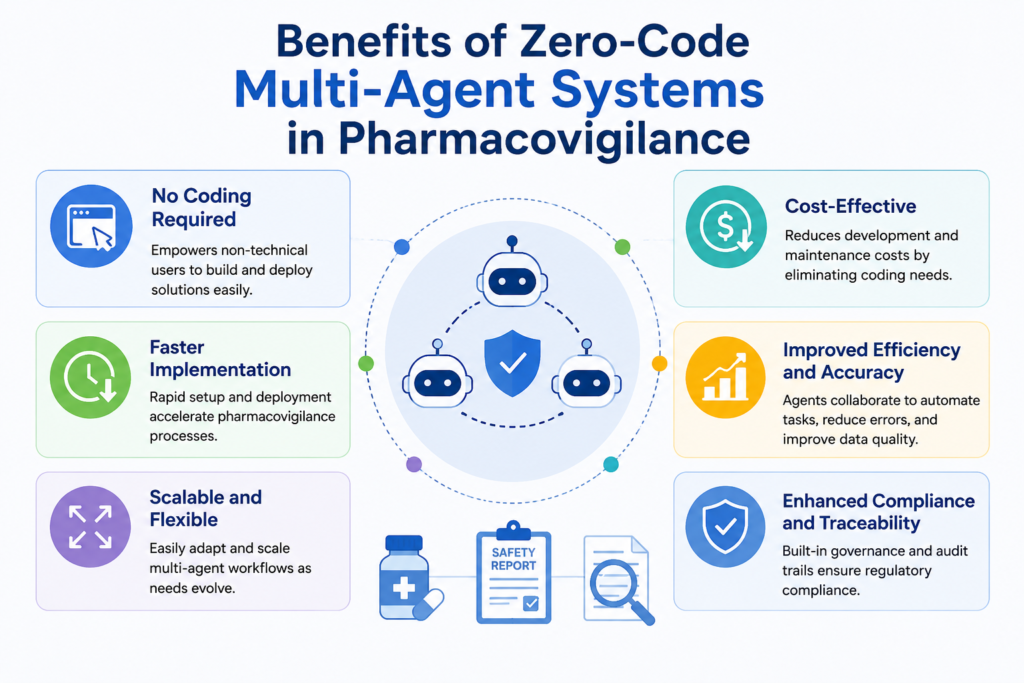
The adoption of zero-code multi-agent systems in pharmacovigilance brings a multitude of benefits, transforming traditional workflows and enhancing overall drug safety. These advantages span from operational efficiencies to strategic improvements in patient safety and regulatory adherence.
- Enhanced Efficiency and Accuracy in Adverse Event Monitoring
One of the most significant benefits of coordinated zero-code architectures is the substantial improvement in the efficiency and accuracy of Adverse Event Monitoring. By automating data ingestion, harmonization, and initial signal detection, these systems drastically reduce the manual effort traditionally associated with pharmacovigilance processes.
This automation allows safety teams to process vast amounts of data much faster than human-centric methods, leading to quicker identification of potential safety signals.
This enhanced precision in Signal Detection in Pharmacovigilance means that critical safety issues are identified earlier, enabling more timely interventions and ultimately safeguarding patient health.
- Bridging the AI Talent Gap with No-Code AI Platforms
The pharmaceutical industry, like many others, faces a persistent challenge in recruiting and retaining AI talent.
The complexity of developing and deploying AI solutions often requires specialized data scientists and AI engineers, creating a talent gap that can impede innovation.
No-Code AI Platforms directly address this issue by empowering pharmacovigilance domain experts—who possess deep knowledge of drug safety regulations and medical contexts—to build and manage AI workflows themselves.
This democratization of AI development accelerates the adoption of AI-Based Pharmacovigilance solutions, making advanced tools accessible to those who understand the nuances of drug safety best. It transforms the way AI Agent Workflows are created and maintained, fostering greater agility and responsiveness to evolving safety needs.
- Proactive Drug Safety Surveillance
Traditional pharmacovigilance is often reactive, identifying safety issues after they have already impacted a significant number of patients. Zero-code multi-agent orchestration facilitates a shift towards Proactive Drug Safety Surveillance.
By continuously monitoring diverse data streams in real-time, these systems can detect subtle emerging trends and patterns that might indicate a new safety signal much earlier than conventional methods.
This continuous vigilance, coupled with the ability to rapidly analyze and prioritize risks, allows pharmaceutical companies to take preventative measures or issue timely warnings, thereby minimizing patient harm.
The ability of these systems to adapt to new data and regulatory requirements quickly means that Drug Safety Monitoring is no longer a static process but a dynamic, intelligent system that actively works to protect public health.
This proactive stance is a hallmark of Intelligent Automation in Healthcare, moving beyond mere compliance to genuine patient protection.
Implementing Zero-Code Multi-Agent Orchestration: Practical Considerations
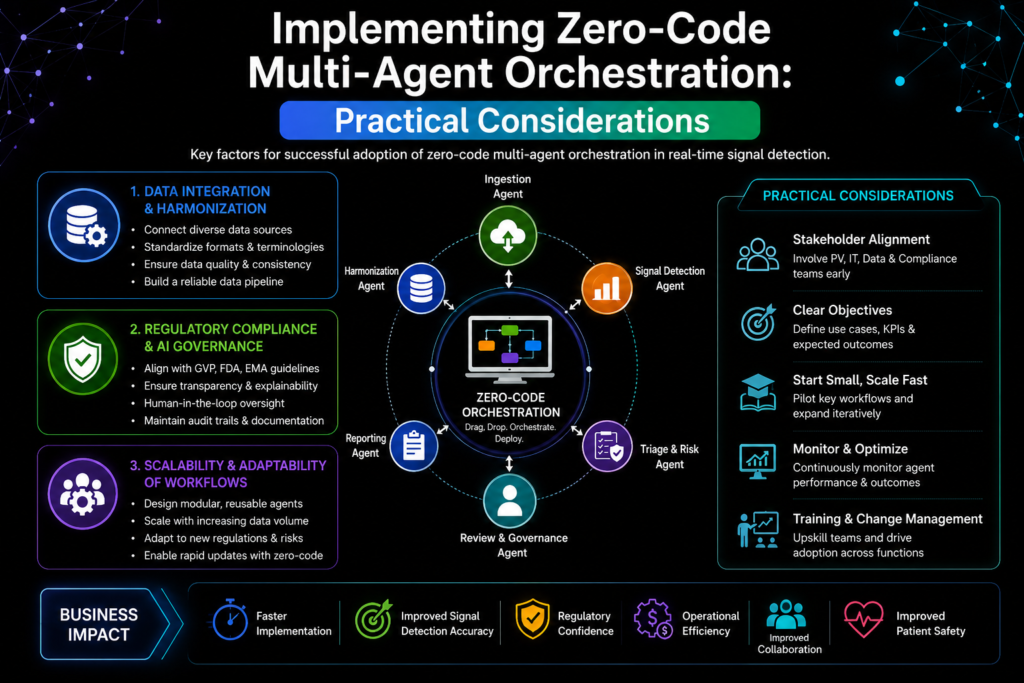
While the benefits of Zero-Code Multi-Agent Orchestration for Pharmacovigilance are clear, successful implementation requires careful consideration of several practical aspects. These include ensuring robust data integration, navigating the complexities of regulatory compliance, and designing for scalability and adaptability.
- Data Integration and Harmonization
The effectiveness of any AI-driven pharmacovigilance system hinges on its ability to access and process high-quality data from a multitude of sources. Healthcare Data Integration is a significant challenge, as data often resides in disparate systems, in varying formats, and with different levels of granularity.
Implementing zero-code multi-agent orchestration necessitates a strategic approach to data ingestion and harmonization.
The goal is to create a unified Pharmacovigilance Data Pipeline that feeds clean, consistent data to the signal detection and analysis agents.
- Ensuring Regulatory Compliance and AI Governance
Pharmacovigilance is a highly regulated field, and any new technology must adhere to stringent guidelines set by bodies like the FDA and EMA. Implementing AI-Based Pharmacovigilance solutions, particularly those involving multi-agent systems, requires a strong focus on Regulatory Pharmacovigilance and AI Governance.
This means ensuring that the AI workflows are transparent, auditable, and explainable. Zero-code platforms can facilitate this by providing visual interfaces for designing workflows, making it easier for domain experts to understand and validate the logic behind AI decisions.
Furthermore, the architecture must incorporate Human-in-the-Loop (HITL) mechanisms, where human experts review and validate critical AI-generated signals and decisions. Comprehensive audit trails, recording every action taken by each agent, are essential for demonstrating compliance during inspections.
- Scalability and Adaptability of AI Workflow Automation
The volume of pharmacovigilance data is constantly growing, and regulatory requirements can change. Therefore, any implemented solution must be designed for scalability and adaptability.
AI Workflow Automation through multi-agent orchestration offers inherent advantages in this regard. The modular nature of agent-based systems allows for easy scaling—new agents can be added or existing ones modified to handle increased data loads or new types of analyses without disrupting the entire system.
This agility ensures that the pharmacovigilance system can continuously evolve, incorporating new data sources, analytical techniques, and regulatory mandates efficiently.
This flexibility is crucial for maintaining effective Drug Safety Surveillance and ensuring that the system remains a valuable asset in the long term, contributing to Enterprise AI Automation in healthcare.
Case Studies and Future Outlook: AI in Drug Safety
The theoretical advantages of Zero-Code Multi-Agent Orchestration for Pharmacovigilance are increasingly being validated through real-world applications and innovative research.
These case studies and forward-looking perspectives highlight the transformative potential of AI in Drug Safety and the future trajectory of intelligent automation in healthcare.
- Real-World Applications of AI-Based Pharmacovigilance
Several organizations are already leveraging AI to enhance their pharmacovigilance capabilities. For instance, platforms like TheNoah.ai demonstrate how zero-code multi-agent systems can be deployed to enable continuous signal detection and efficient risk prioritization.
These platforms offer pre-trained workflows and domain-specific agents that can be rapidly configured to connect various data sources, from ICSR databases to literature repositories, without requiring extensive coding
.This rapid deployment capability allows pharmaceutical companies to achieve significantly faster AI adoption, moving from development cycles that once took years to days.
.
- The Future of Intelligent Automation in Healthcare
The trajectory of Intelligent Automation in Healthcare points towards increasingly autonomous and sophisticated AI systems.
The future of AI Agent Workflows in pharmacovigilance is likely to involve agents that can not only detect signals but also initiate preliminary benefit-risk analyses, draft signal validation reports, and even monitor global health authority websites for regulatory changes, automatically suggesting updates to standard operating procedures (SOPs).
This move towards more proactive and self-adapting systems will further reduce the burden on human safety scientists, allowing them to focus on complex decision-making and strategic oversight.
Conclusion
The journey of pharmacovigilance from retrospective, manual processes to continuous, intelligent, and orchestrated systems marks a significant leap forward in drug safety. Zero-Code Multi-Agent Orchestration for Pharmacovigilance stands at the forefront of this transformation, offering a powerful paradigm shift in how adverse drug events are detected, analyzed, and managed.
The architectures discussed, comprising specialized agents for data ingestion, signal detection, risk prioritization, and human-in-the-loop governance, collectively ensure that pharmacovigilance moves from a reactive stance to a proactive one.
This not only enhances the efficiency and accuracy of Real-Time Signal Detection but also strengthens regulatory compliance and patient safety.
As the pharmaceutical landscape continues to evolve, the adoption of zero-code multi-agent systems will be instrumental in building more resilient, intelligent, and responsive drug safety surveillance frameworks, ultimately contributing to better patient outcomes worldwide.