

Introduction
SEO reputation management is no longer a mere advantage.
It is a fundamental pillar of business success. The search engine results page (SERP) functions as a brand’s digital storefront.
Next, and the information presented on the first page profoundly influences consumer trust, credibility, and conversion rates. In addition , a strong and positive presence on Google can be the deciding factor between a thriving business and one struggling to gain market traction.
What Is SEO Reputation Management?
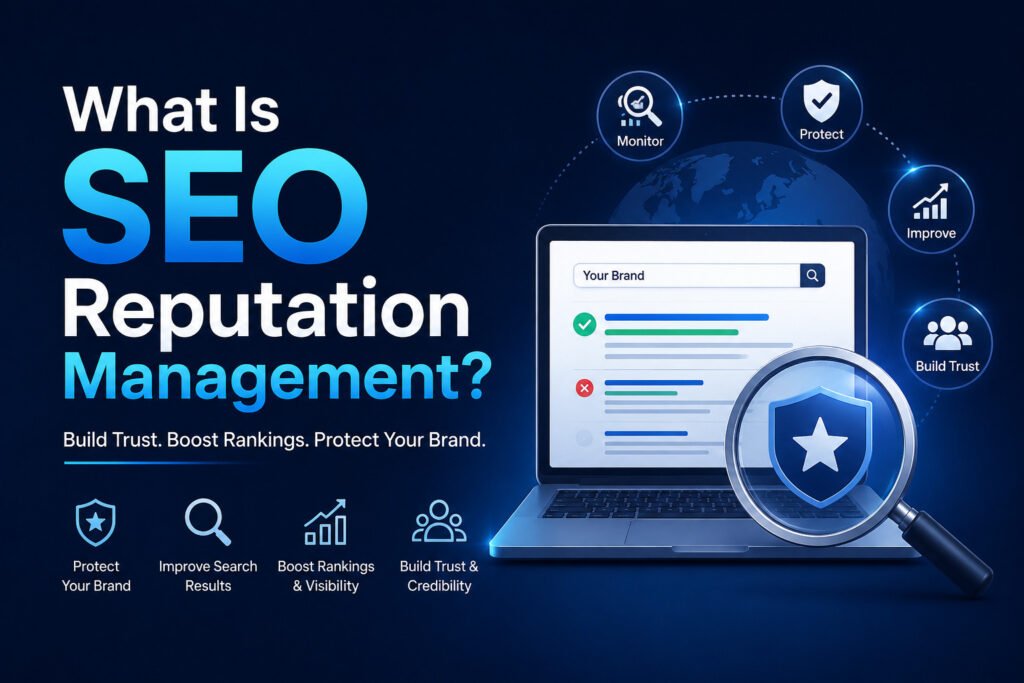
Because, SEO Reputation Management is a strategic and proactive process designed to influence and optimize a brand’s online presence within search engine results. Furthermore Its primary objective is to build, maintain, and safeguard a positive public perception. This discipline ensures that when individuals search for a brand, its products, or services, they encounter accurate, positive, and authoritative information that reinforces trust and encourages engagement.
Why SEO Reputation Management Matters in 2026
However 2026, the importance of SEO Reputation Management will have intensified due to several pivotal factors Although:
- AI-Powered Search Dominance: AI search engines, such as Google’s AI Overviews, ChatGPT, and Gemini, are increasingly synthesizing information to deliver direct answers to user queries. If a brand is not recognized as a credible source. It will not be cited leading to a significant. Impact on its visibility and the trust consumers place in it.
- Zero-Click Searches: A growing number of users are obtaining answers directly. Furthermore SERP without navigating to a website. This phenomenon underscores the critical importance of controlling the information displayed directly on the search results page.
- Consumer Trust: Modern consumers exhibit a high degree of discernment. They meticulously research brands before making purchasing decision. Also negative search results can instantaneously erode trust and deter potential customers.
How the SEO Reputation Management Guide Works
Moreover SEO Reputation Management operates through a systematic approach of identifying.creating, optimizing and promoting digital assets, that cast a positive light on a brand. This comprehensive process encompasses Furthermore;
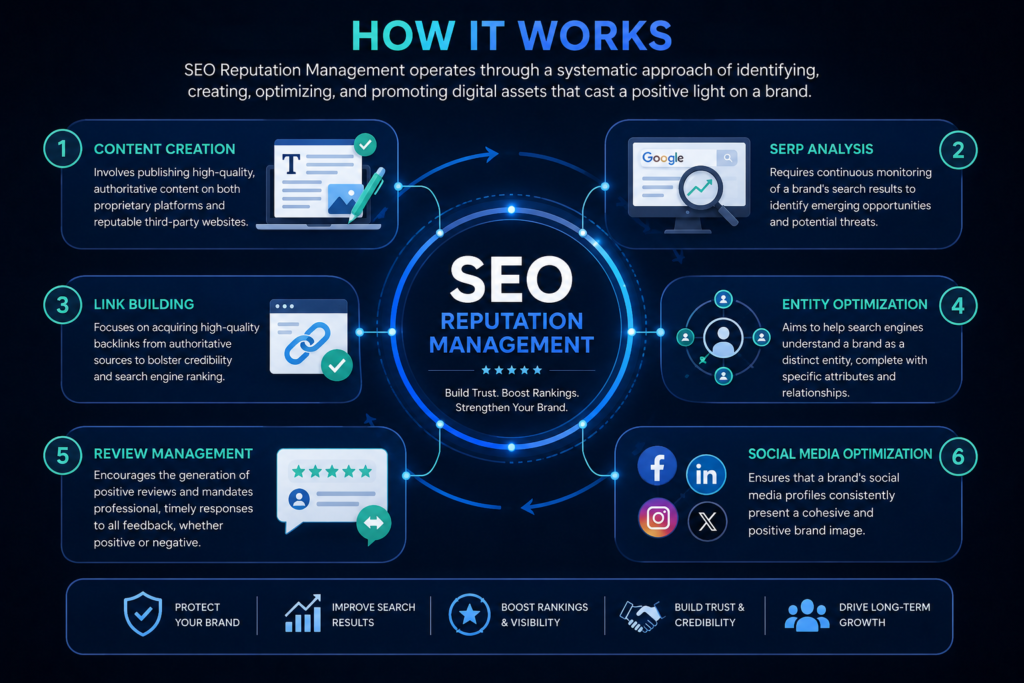
- Content Creation: Furthermore ,Involves publishing high-quality. Authoritative content on both proprietary platforms and reputable third-party websites.
- SERP Analysis: Instead requires continuous monitoring of a brand’s search results to identify emerging opportunities and potential threats.
- Link Building: Focuses on acquiring high-quality backlinks from authoritative sources to bolster credibility and search engine ranking.
- Entity Optimization: Furthermore ,aims to help search engines understand a brand as a distinct entity, complete with specific attributes and relationships.
- Review Management: Encourages the generation of positive reviews and mandates professional, timely responses to all feedback, whether positive or negative.
- Social Media Optimization: Ensures that a brand’s social media profiles consistently present a cohesive and positive brand image.
Key Objectives of SEO Reputatio
In addition the primary objectives underpinning SEO Reputation Management are multifaceted and crucial for sustained digital success:
- Enhance Brand Visibility: To ensure that positive, owned, and earned media assets achieve prominent rankings for brand-related search queries.
- Build Trust and Credibility: To firmly establish the brand as an authoritative and trustworthy source of information within its industry.
- Mitigate Negative Content: To actively suppress or dilute the visibility of unfavorable search results, thereby minimizing their impact.
- Improve Click-Through Rate (CTR): To optimize SERP snippets in order to encourage users to click on the brand’s desired content.
- Increase Conversions: To drive a greater volume of qualified traffic to the brand’s website by cultivating a positive initial impression among potential customers.
Benefits of SEO Reputation Management for Businesses
Businesses that proactively engage in SEO Reputation Management .Realize a multitude of significant benefits.which collectively contribute to long-term growth and stability Next:
- Increased Brand Equity: A robust online reputation significantly enhances the overall value and public perception of a brand.
- Higher Organic Traffic: Dominating brand-specific SERPs leads to a greater influx of direct and highly qualified visitors to the brand’s digital properties.
- Improved Conversion Rates: Trustworthy brands are inherently more effective at converting website visitors into loyal customers.
- Competitive Advantage: Excelling in reputation signals provides a distinct edge, allowing a brand to differentiate itself from competitors.
SEO Reputation Management vs. ORM vs. PR vs. Brand Management
Although while frequently used interchangeably.SEO Reputation Management Online Reputation Management (ORM). Public Relations (PR) and Brand Management. Are distinct disciplines each with unique focuses yet overlapping objectives. A clear understanding of their differences is essential for formulating a truly holistic strategy.
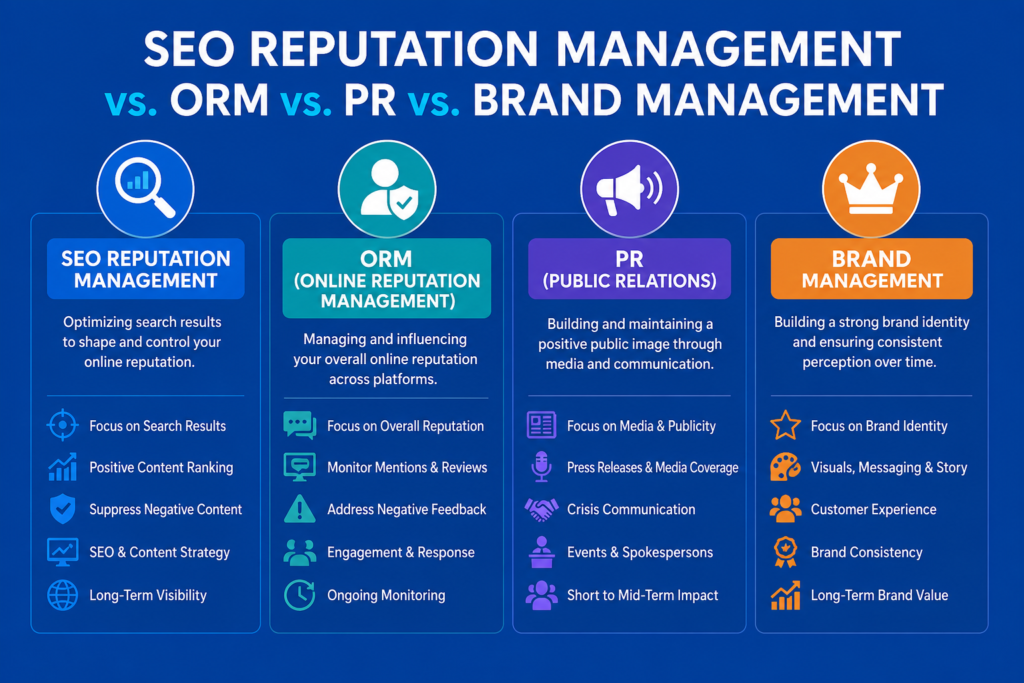
| Feature | SEO Reputation Management | Online Reputation Management (ORM) | Public Relations (PR) | Brand Management |
| Purpose | Influence search engine results for positive brand perception | Monitor and influence overall online perception | Manage public perception and media relations | Shape the overall identity and perception of a brand |
| Goal | Dominate brand SERPs, build E-E-A-T, drive organic CTR | Protect and enhance brand image across all digital channels | Build positive relationships with media and stakeholders | Ensure brand consistency, value, and market position |
| Channels | Google Search, AI Search, owned digital assets, third-party sites | Social media, review sites, forums, news, search engines | Media outlets, press releases, events, influencer marketing | All brand touchpoints (marketing, product, customer service) |
| Timeline | Long-term, continuous effort (weeks to months for impact) | Ongoing, often reactive to mentions (immediate to long-term) | Event-driven, campaign-based (short to medium-term) | Continuous, strategic (long-term) |
| KPIs | Brand SERP dominance, organic CTR, E-E-A-T signals, AI citations | Sentiment analysis, brand mentions, review scores, engagement | Media mentions, press coverage, audience reach, brand sentiment | Brand awareness, loyalty, market share, brand equity |
| Best Use Cases | Proactive brand building, E-E-A-T enhancement, negative SERP suppression | Crisis management, review management, social listening | Product launches, corporate announcements, thought leadership | Brand positioning, market differentiation, customer experience |
| Search Visibility Impact | Direct and significant impact on organic search rankings and AI citations | Indirect impact through sentiment and content generation | Indirect impact through earned media and backlinks | Indirect impact through overall brand strength and authority |
Why SEO Reputation Management Matters More Than Ever
Although, the digital landscape is in a state of perpetual evolution, and concurrently. The significance of SEO Reputation Management continues its upward trajectory. Several overarching trends underscore. why this discipline,Is no longer an optional consideration but an ,Indispensable necessity for any brand aspiring to achieve sustained success.

1. The Rise of AI-Powered Search in SEO Reputation Management
Although artificial intelligence has fundamentally reshaped the manner.Also in which search engines process and present information. Google for instance has progressed beyond rudimentary .Instead keyword matching now endeavoring to comprehend. The underlying intent behind a user’s query and synthesizing .Moreover information from a multitude of sources to furnish comprehensive answers.
2. Zero-Click Searches Dominate
Also increasing proportion of users are successfully obtaining Tthe information they require directly on the search engine results page (SERP). Furthermore without ever needing to click through to a website. These are colloquially ,For this reason
“zero-click searches.”For example, A study by Similarweb in 2020 indicated. That nearly 65% of Google searches concluded without a click to another web property This compelling trend accentuates the critical imperative to meticulously control the information that is directly displayed on the SERP, encompassing featured snippets, knowledge panels, and local packs.
3. Google AI Overviews: The New Frontier
Google AI Overviews (previously known as Search Generative Experience or SGE) .Tepresent a monumental shift in Google’s methodology for information delivery. These AI-generated summaries are prominently displayed at the apex of the SERP. Furnishing succinct and comprehensive answers to complex queries.
4. Brand Trust Signals Are Paramount
In addition, epoch characterized by the proliferation of misinformation and intense market competition, brand trust has ascended to the status of a non-negotiable asset. For this reason these crucial signals encompass:
- Positive Reviews and Ratings: High ratings on influential platforms such as Google My Business, Yelp, Trustpilot, and industry-specific review sites function as powerful indicators of trust.
- Authoritative Backlinks: Inbound links originating from reputable websites signal to search engines that a brand’s content is both valuable and trustworthy.
- Media Mentions: Favorable coverage in esteemed news outlets and pertinent industry publications significantly augments brand authority.
- Social Proof: An active and engaged presence across social media platforms can effectively foster community and cultivate trust among consumers.
5. Evolving Consumer Behavior in SEO Reputation Management
Empirical data pertaining to consumer behavior consistently corroborates the profound importance of online reputation. For example, consumers often rely on online reviews when evaluating a business.
- A staggering 93% of consumers assert that online reviews directly influence their purchasing decisions. (Podium. State of Online Reviews Report (2021).
- In 2023, 87% of consumers reported reading online reviews for local businesses. (BrightLocal. Local Consumer Review Survey 2023.
- Approximately 79% of consumers place as much trust in online reviews as they do in personal
Furthermore, collectively paint an unequivocal picture: a brand’s online reputation, particularly its manifestation within search results, directly impacts consumer perception, trust, and ultimately, its financial performance.
How Google Evaluates Your Brand Reputation
Although Google’s sophisticated algorithms are meticulously engineered to furnish users with the most relevant, reliable, and high-quality information available

1. E-E-A-T: Experience, Expertise, Authoritativeness, and Trustworthiness
Moreover, E-E-A-T stands as a foundational cornerstone of effective SEO reputation management. Google’s Quality Rater Guidelines .And constitutes a critical determinant in how a brand is perceived. However, it is not a direct ranking factor in itself, but rather a comprehensive set of principles that guide Google’s algorithms in evaluating the overall quality and reliability of content and its creators.. To effectively demonstrate robust E-E-A-T:
- Experience: It is imperative to showcase that content is generated by individuals possessing first-hand experience of the subject matter.
- Expertise: The qualifications and profound knowledge of content creators and the organization itself must be prominently highlighted.
- Authoritativeness: A brand must establish itself as a preeminent voice within its industry through judicious citation building, mentions, and high-quality backlinks originating from reputable sources.
- Trustworthiness: The website must be secure, transparent, and consistently provide accurate, unbiased information. Additionally, this includes readily accessible contact information, clear privacy policies, and an impeccable track record of positive customer interactions.
2. Reviews and Ratings
Furthermore, customer reviews and ratings, disseminated across platforms such as Google My Business, Yelp, Trustpilot, and various industry-specific sites, serve as potent indicators of reputation. Google leverages these signals to ascertain customer satisfaction levels and the prevailing sentiment surrounding a brand.
3. Backlinks
Furthermore, backlinks, also known as inbound links, originating from other websites to one’s own, continue to constitute a fundamental ranking factor. However, the emphasis is not solely on the sheer quantity of links, but rather on their intrinsic quality and contextual relevance. Links acquired from authoritative, trustworthy websites within a brand’s industry function as powerful endorsements, signaling to Google that the brand is a credible source of information.
4. Entity SEO
Specifically, Entity SEO is a specialized approach focused on assisting search engines in comprehending a brand as a distinct “entity,” a real-world concept possessing specific attributes and relationships.. This involves the strategic implementation of structured data, meticulous optimization of the Google Business Profile, and ensuring absolute consistency of information across the entire web.
5. Brand Mentions
Moreover, Google diligently monitors the frequency and contextual nuances of a brand’s mentions across the vast expanse of the web, even in instances where a direct hyperlink is absent. These unlinked brand mentions serve as a potent signal of a brand’s popularity and influence.
6. User Behavior
Additionally, the manner in which users interact with a brand’s presence within search results furnishes Google with invaluable feedback. Similarly, signals such as the click-through rate (CTR) from the SERP, the duration of time spent on a brand’s website, the bounce rate, and the frequency of repeat visits all collectively contribute to Google’s understanding of user satisfaction.
7. Content Quality
Furthermore, high-quality, comprehensive, and genuinely helpful content forms the bedrock of a robust online reputation. Google prioritizes content that authentically addresses user queries, unequivocally demonstrates expertise, and provides unique, tangible value.
8. Freshness
Moreover, for a multitude of topics, particularly those characterized by time-sensitivity or rapid evolution, the freshness of content emerges as a crucial ranking factor. Google’s overarching objective is to provide users with the most current and up-to-date information.
9. Authority
Additionally, authority, within Google’s intricate framework, represents a cumulative measure of a brand’s overall standing and influence within its specific niche. Furthermore, it is meticulously constructed through a synergistic combination of all the aforementioned factors: a strong E-E-A-T profile, a consistent stream of positive reviews, a robust portfolio of high-quality backlinks, consistent brand mentions, and exemplary user engagement.
The Search Trust Pyramid™: A Framework for Dominance
Moreover, to systematically build and maintain a formidable online reputation, brands can leverage the Search Trust Pyramid™“Furthermore, this hierarchical framework outlines the essential layers of reputation management, from foundational elements to advanced strategies:”
- Foundational Layer: Technical SEO & Brand Consistency
- Secure Website (HTTPS): Essential for trust and security.Mobile-Friendliness: Critical for user experience and rankings.
- Page Speed: Fast loading times improve user satisfaction and SEO.
- Structured Data (Schema Markup): Helps search engines understand your content and brand entity.
- NAP Consistency (Name, Address, Phone): Crucial for local SEO and entity recognition across directories.
- Brand Guidelines: Ensure consistent messaging, visuals, and tone across all online touchpoints.
- Core Layer: Content & Engagement
- High-Quality, E-E-A-T Content: Authoritative articles, blog posts, whitepapers, and guides that demonstrate expertise.
- User-Generated Content (UGC): Encourage testimonials, case studies, and customer stories.
The AI Reputation Flywheel™: Continuous Improvement
“Furthermore, the AI Reputation Flywheel™ illustrates the cyclical and self-reinforcing nature of SEO Reputation Management in the age of AI. Additionally, each component feeds into and strengthens the others, creating a continuous loop of improvement:”
- Create E-E-A-T Driven Content: Produce high-quality, expert-backed content that addresses user needs and demonstrates authority.
- Gain AI Citations & SERP Visibility: As content gains authority, it is more likely to be cited by AI Overviews and rank prominently in traditional SERPs.
- Drive User Engagement & Trust: Increased visibility leads to more clicks, longer dwell times, and positive user interactions, signaling trust to Google.
- Generate Positive Brand Signals: Engaged users leave reviews, share content, and mention the brand, further enhancing its reputation.
- Reinforce E-E-A-T & Authority: These positive signals, in turn, reinforce the brand’s E-E-A-T, making its content even more likely to be trusted and cited by AI and traditional search algorithms.
“Therefore, this flywheel effect ensures that consistent effort in SEO Reputation Management yields compounding returns. Consequently, it solidifies a brand’s position as a trusted authority.”
Practical Strategies for SEO Reputation Management in 2026
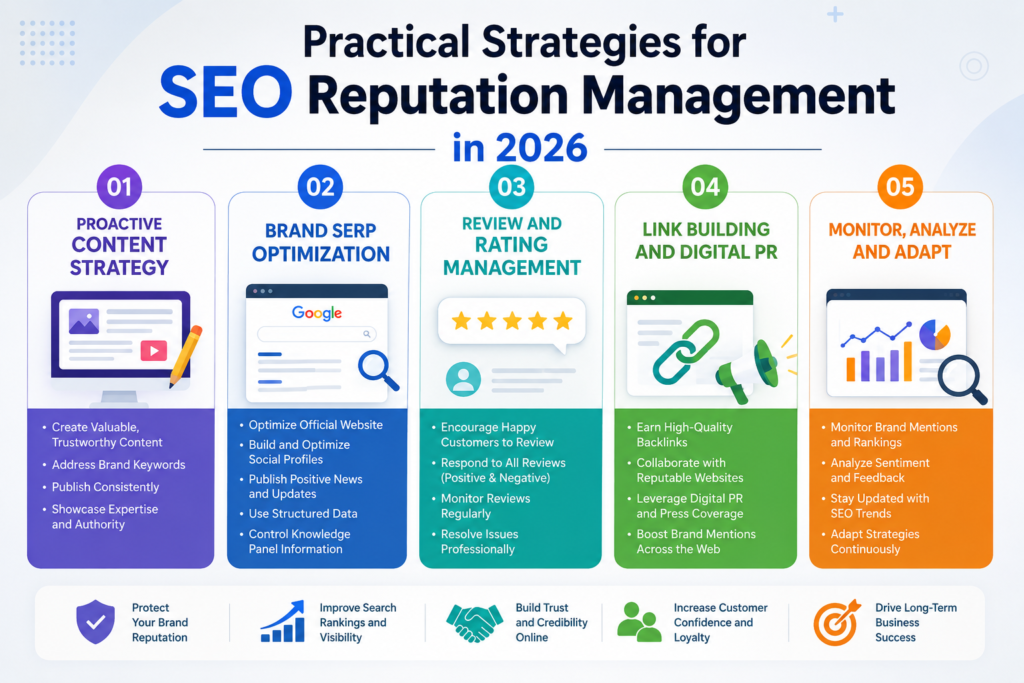
“Additionally, implementing an effective SEO Reputation Management strategy requires a multi-pronged approach. Here are key practical strategies:”
1. Proactive Content Strategy
- Own Your Narrative: Create a wealth of positive, high-quality content on your owned properties (website, blog, official social media profiles) that accurately reflects your brand message.
- Answer All Questions: Develop comprehensive content that directly answers common questions about. your brand, products, and services. This helps control the narrative and positions you as an authoritative source.
- Thought Leadership: Publish industry insights, research, and expert opinions to establish your brand as a leader and go-to resource.
- Content Diversification: Utilize various content formats – articles, videos, infographics, podcasts – to cater to different user preferences and increase visibility across multiple platforms.
2. Brand SERP Optimization
Your Brand SERP (Search Engine Results Page for your brand name) is your digital business card. Optimizing it means:
- Dominating the First Page: Aim to fill the entire first page of Google for your brand name with positive, owned, and earned assets.
- Knowledge Panel Control: Ensure your Google Knowledge Panel is accurate, up to date, and showcases positive information. Claim and optimize your Google Business Profile.
- Rich Snippets & Schema: Implement schema markup to enhance your SERP listings with rich snippets (e.g., star ratings, FAQs, product information), making them more appealing and informative.
- Social Profile Optimization: Ensure your official social media profiles (LinkedIn, X, Facebook, Instagram, YouTube) rank prominently and present a consistent, positive brand image.
3. Review and Rating Management
Reviews are a cornerstone of online trust. A robust strategy includes:
- Active Solicitation: Proactively encourage satisfied customers to leave reviews on relevant platforms (Google My Business, Trustpilot, industry-specific sites).
- Prompt Responses: Respond to all reviews, both positive and negative. In a professional and empathetic manner. Address negative feedback constructively and offer solutions.
- Review Monitoring: Use tools to monitor new reviews and ratings in real time, enabling swift action.
- Leverage Positive Reviews: Showcase positive testimonials on your website and marketing materials to build social proof.
4. Link Building and Digital PR
High-quality backlinks and media mentions are powerful reputation signals:
- Earned Media: Focus on creating newsworthy content or initiatives that attract media attention and natural backlinks.
- Strategic Outreach: Build relationships with journalists, bloggers, and industry influencers to secure positive mentions and editorial links.
- Broken Link Building: Identify broken links on authoritative websites and suggest your relevant content as a replacement.
- Guest Posting: Contribute valuable content to reputable industry blogs with a link back to your site.
5. Crisis Management & Negative Content Suppression
Even with the best proactive measures, negative content can emerge. A crisis management plan is essential:
- Early Detection: Implement robust monitoring systems to detect negative mentions or content as soon as they appear.
- Rapid Response: Address negative content swiftly and strategically. This might involve issuing official statements, engaging directly, or initiating legal action if necessary.
- Content Dilution: Create a large volume of positive, optimized content to push negative results further down the SERP.
- Legal & Removal Options: Explore legal avenues for defamation or content removal requests if the content is false, misleading, or violates platform policies.
Measuring Success: Key Performance Indicators (KPIs)
“Therefore, to gauge the effectiveness of your SEO Reputation Management efforts, track these key performance indicators:”
- Brand SERP Dominance: The percentage of the first page of Google for your brand name that is controlled by positive, owned, or earned assets.
- Organic Branded CTR: The click-through rate for your brand-related search queries.
- Brand Search Volume: The number of times your brand name is searched for.
- Sentiment Analysis: Monitoring the overall sentiment (positive, neutral, negative) of online mentions.
- Review Scores: Average ratings on key review platforms.
- E-E-A-T Signals: Growth in authoritative backlinks, media mentions, and expert citations.
- AI Citations: How often your brand is cited as a source in AI Overviews or generative search results.
- Knowledge Panel Visibility & Accuracy: Presence and correctness of your Google Knowledge Panel.
- Negative SERP Entries: The number and position of unfavorable search results.
Future Trends in SEO Reputation Management

Looking ahead, several trends will continue to shape the field of SEO Reputation Management:
- Hyper-Personalization: “Moreover, AI will enable even more personalized search results, making it crucial for brands to maintain a consistent and positive reputation across all user segments.”
- Voice Search Optimization:“Furthermore, as voice search grows, optimizing for conversational queries and ensuring your brand is the authoritative answer will become paramount.”
- Visual Search & Image Recognition: Managing the reputation of your brand’s visual assets will gain importance.
- Blockchain & Decentralized Identity: Potential for new ways to verify brand authenticity and manage reputation in decentralized environments.
- Ethical AI & Transparency: “Instead, brands will need to demonstrate ethical AI practices and transparency in their data usage to maintain trust.”
Conclusion:
Finally dynamic and increasingly AI-driven digital landscape of 2026. A brand’s online reputation is not merely a reflection of its identity.It is a fundamental driver of trust conversions and long-term success. SEO Reputation Management emerges as the proactive. Strategic discipline that empowers brands to meticulously control .Their narrative across “Moreover, Google and the burgeoning AI search ecosystem can be better understood by deeply analyzing how search engines evaluate brand reputation.” .As a result by diligently implementing the comprehensive frameworks discussed . Furthermore the Search Trust Pyramid™ and the AI Reputation Flywheel™ . Businesses can forge a resilient, positive online presence that not only withstands .The tests of time but thrives amidst constant technological evolution.