
Introduction
The real estate industry is undergoing a profound transformation driven by Artificial Intelligence (AI) and AI agents. These intelligent systems are revolutionizing property searches, valuations, customer service, and transaction management. However, the immense potential of AI in real estate is coupled with a critical need for robust **AI agent governance**. Without proper oversight, AI agents can introduce significant risks, including algorithmic bias, privacy breaches, and ethical dilemmas, impacting real estate companies, professionals, and consumers.
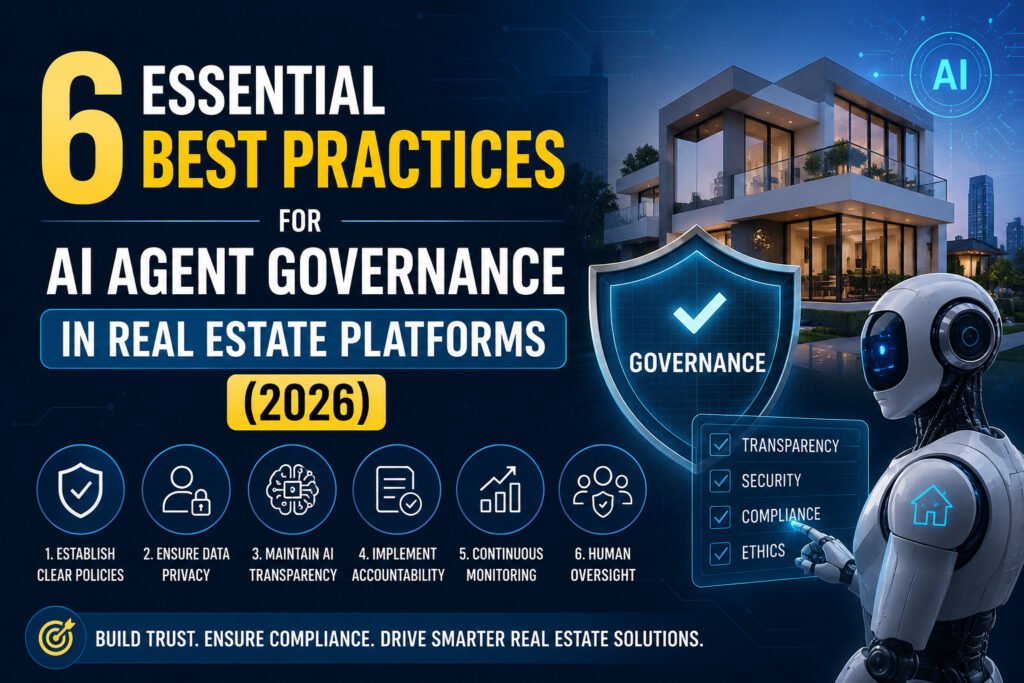
This article outlines **six essential best practices for AI agent governance** that real estate platforms—including companies, brokerages, proptech firms, MLS platforms, and technology providers—must implement. We aim to provide an authoritative, engaging, and reader-friendly guide for real estate professionals, business leaders, technology managers, and AI decision-makers. Our focus is on balancing innovation with ethical responsibility, ensuring AI agents are deployed ethically, transparently, and effectively to foster trust and drive sustainable growth in the dynamic real estate market.
The Imperative of AI Agent Governance in Real Estate
The rapid growth of AI agents in real estate offers vast opportunities but also significant challenges. While AI enhances efficiency and decision-making, its autonomous nature demands robust AI governance. Without clear oversight, AI deployment risks ethical breaches, legal liabilities, and eroded public trust.
Why AI Governance Matters Now More Than Ever
AI adoption is accelerating; approximately **18% of firms adopted AI by late 2025** [1]. In real estate, specific applications like **property valuation AI**, **tenant screening AI**, and **AI-driven marketing** introduce unique risks, including historical biases and **AI hallucinations**. High financial and reputational stakes make proactive **AI governance in real estate** essential for sustainable innovation. Effective governance ensures **AI systems** align with societal values, legal mandates, and ethics, safeguarding consumers and fostering a fair **real estate market**.
Establish a Clear Organizational Philosophy and Oversight
Effective AI agent governance begins with a foundational commitment from leadership to define how AI will be used, managed, and monitored across all operations.
This involves articulating a clear organizational philosophy that balances the pursuit of innovation with an unwavering commitment to accountability, legal compliance, and stakeholder trust.
For real estate entities, this philosophy should address how AI agents will interact with sensitive data, influence critical decisions (e.g., property valuations, tenant screenings), and impact various stakeholders, including agents, buyers, sellers, landlords, and tenants.

Key Actions:
Develop an AI Governance Framework:
- Create a formal framework that outlines policies, procedures, and responsibilities for the entire life cycle of AI agents, from development and deployment to monitoring and decommissioning.
- This framework should be adaptable to the specific type of housing or service provided, the resident community, and applicable laws.
Appoint an AI Governance Committee:
- Establish a cross-functional committee comprising legal, ethics, technology, and business leaders.
- This committee will be responsible for overseeing the implementation of the AI governance framework, reviewing AI initiatives, and making decisions on complex ethical or compliance issues.
Define Roles and Responsibilities:
- Clearly delineate who is responsible for what in the AI agent lifecycle.
- This includes data scientists, developers, product managers, legal counsel, and business unit leaders.
- Ensure that there are clear lines of accountability for AI agent performance and outcomes.
Integrate AI Governance into Corporate Strategy:
- AI governance should not be an afterthought but an integral part of the overall corporate strategy.
- This ensures that AI initiatives are aligned with the company’s values and long-term objectives, and that resources are allocated appropriately for responsible AI development and deployment.
Prioritize Fairness, Consumer Protection, and Bias Mitigation
One of the most critical aspects of AI agent governance in real estate is ensuring fairness and protecting consumers from algorithmic bias.
AI systems, if not carefully designed and monitored, can inadvertently perpetuate or even amplify existing societal biases, leading to discriminatory outcomes in areas such as housing access, loan approvals, and property valuations.
This is particularly pertinent in real estate, where regulations like the Fair Housing Act are designed to prevent discrimination.
Key Actions:
Conduct Regular Bias Audits:
- Implement rigorous and regular audits of AI models and data sets to identify and mitigate biases.
- This includes evaluating training data for demographic imbalances and testing model outputs for disparate impacts across different protected classes.
Adhere to Fair Housing and Consumer Protection Laws:
- Ensure that all AI systems comply with applicable provisions of the Fair Housing Act, Fair Credit Reporting Act, the Americans with Disabilities Act, and relevant state and local data regulations
- Legal teams should be actively involved in the development and deployment phases of AI agents.
Implement Explainable AI (XAI) Techniques:
- While full explainability can be challenging, strive to use XAI techniques that allow for a better understanding of how AI agents arrive at their decisions.
- This can help in identifying and rectifying biased decision-making processes.
Establish Redress Mechanisms:
- Create clear and accessible channels for consumers to challenge AI-driven decisions they believe are unfair or discriminatory.
- This includes human review processes for appeals and a commitment to rectify errors promptly.
- Recent legal cases highlight the importance of this, with settlements in cases like Louis v. SafeRent Solutions demonstrating the financial and reputational risks of AI discrimination.
Promote Diverse Development Teams:
- Foster diversity within AI development teams.
- Diverse perspectives can help identify potential biases early in the development cycle and lead to more equitable AI solutions.
Ensure Transparency and Explainability
Transparency and explainability are paramount in building trust and ensuring accountability in AI agent deployments within real estate. Stakeholders, including real estate professionals, consumers, and regulators, need to understand when AI is influencing decisions and how those decisions are being made. This is especially crucial in real estate, where decisions can have significant financial and personal impacts.
Key Actions:
Disclose AI Involvement:
- Clearly communicate to users and stakeholders when AI agents are involved in processes that affect them.
- This includes informing renters and applicants when AI influences key decisions in the customer journey, such as tenant screening or property recommendations [1].
Provide Understandable Explanations:
- When AI agents make decisions that impact individuals, provide clear, concise, and understandable explanations for those decisions.
- Avoid technical jargon and focus on the factors that led to the outcome. This is often a legal requirement, particularly in areas like credit decisions.
Document AI System Logic:
- Maintain comprehensive documentation of AI agent design, development, and operational logic.
- This includes details on data sources, algorithms used, model training processes, and decision-making parameters.
- Such documentation is vital for internal audits, regulatory compliance, and troubleshooting.
Address AI Hallucinations:
- Be aware of and actively mitigate the risk of AI “hallucinations,” where AI systems generate information that sounds plausible but is factually incorrect.
- In real estate, this could lead to misleading property descriptions, inaccurate market analyses, or incorrect legal advice, all of which can have serious consequences.
- Implement validation mechanisms to cross-reference AI-generated content with reliable data sources.
Promote a Culture of Transparency:
- Foster an organizational culture that values transparency in AI development and deployment.
- Encourage open dialogue about the capabilities and limitations of AI agents, both internally and externally.
Protect Privacy and Promote Data Integrity
In the real estate sector, AI agents often process vast amounts of sensitive personal and financial data. Protecting this data and ensuring its integrity is not only a legal obligation but also a cornerstone of maintaining consumer trust. Breaches of privacy or compromised data integrity can lead to severe reputational damage, significant financial penalties, and erosion of consumer confidence.

Key Actions:
Adhere to Data Privacy Laws:
- Strictly comply with all federal, state, and local consumer privacy laws, such as GDPR, CCPA, and other relevant regulations.
- This includes implementing robust data protection measures and ensuring that data collection, storage, and processing practices are legally sound.
Implement Data Minimization:
- Adopt the principle of data minimization, collecting only the data that is absolutely necessary for the AI agent’s intended purpose.
- Regularly review and purge unnecessary data to reduce the risk exposure
Ensure Data Security:
- Implement state-of-the-art cybersecurity measures to protect data from unauthorized access, breaches, and cyberattacks.
- This includes encryption, access controls, regular security audits, and employee training on data security best practices.
Obtain Informed Consent:
- Clearly inform individuals about what data is being collected by AI agents, how it will be used, and with whom it will be shared.
- Obtain explicit and informed consent, especially for sensitive data or novel uses of AI.
Promote Data Integrity:
- Establish processes to ensure the accuracy, completeness, and consistency of data used by AI agents.
- Poor data quality can lead to flawed AI decisions, which can have serious consequences in real estate transactions and services.
- Implement data validation, cleansing, and reconciliation procedures.
Maintain Outcome-Based Accountability and Human Involvement
While AI agents offer unparalleled efficiency and analytical capabilities, human oversight remains indispensable, especially in high-stakes decisions within the real estate domain. Establishing clear accountability for AI-driven outcomes and ensuring meaningful human involvement are crucial for responsible AI governance. This approach helps to prevent unintended consequences, build trust, and provide recourse when AI systems make errors or produce undesirable results.

Key Actions:
Engage Humans in Significant Decisions:
- Implement a ‘human-in-the-loop’ approach for critical decisions in the customer journey that are influenced by AI.
- This means that while AI agents can provide recommendations or automate routine tasks, significant decisions (e.g., final approval of a loan, complex property valuation adjustments, or tenant eviction notices) should always involve human review and approval.
Establish Review and Escalation Channels:
- Develop clear processes for reviewing AI model outcomes and provide accessible escalation channels for complaints and appeals.
- This ensures that individuals affected by AI decisions have a mechanism to seek clarification or challenge outcomes, with human intervention available to resolve disputes.
Educate Staff on AI Tools:
- Provide comprehensive training to staff on the effective use and limitations of AI tools.
- Real estate professionals should understand how AI agents function, their potential biases, and when human judgment is necessary to override or refine AI-generated recommendations [1].
Develop Continuous Testing and Evaluation:
- Implement ongoing testing and evaluation mechanisms to ensure that AI tools remain aligned with applicable laws, business goals, and ethical guidelines.
- This includes performance monitoring, drift detection, and regular audits to assess the real-world impact of AI agents on various stakeholders.
Focus on Outcome-Based Accountability:
- Shift the focus from merely monitoring AI inputs and processes to evaluating the actual outcomes produced by AI agents.
- This involves tracking key performance indicators related to fairness, accuracy, and consumer satisfaction, and holding relevant teams accountable for these results.
Encourage Third-Party Partner Accountability and Due Diligence
In today’s interconnected real estate ecosystem, it’s common for companies to leverage third-party AI tools, platforms, and data sources. While these partnerships can accelerate innovation and enhance capabilities, they also introduce additional layers of risk.

Key Actions:
Implement Robust Due Diligence:
- Before engaging with any third-party AI provider, conduct thorough due diligence to assess their AI governance practices, data security protocols, ethical guidelines, and compliance with relevant regulations.
- This includes evaluating their data sources, model limitations, and known risks.
Incorporate AI Governance into Contracts:
- Ensure that contracts with third-party AI providers explicitly outline expectations for AI governance, including data privacy, security, bias mitigation, transparency, and accountability.
- Include clauses that allow for audits and performance reviews of their AI systems.
Demand Transparency from Third Parties:
- Require third-party partners to provide transparency regarding their AI models, data sources, and any potential biases or limitations.
- This information is crucial for real estate platforms to understand and manage the risks associated with external AI solutions.
Align with Organizational Standards:
- Ensure that third-party AI tools and services align with the real estate company’s established risk management and AI governance practices.
- Discrepancies can create vulnerabilities and undermine the overall governance framework.
Continuous Monitoring of Third-Party AI:
- Regularly monitor the performance and compliance of third-party AI solutions.
- This includes reviewing their updates, assessing their impact on business operations and consumer outcomes, and staying informed about any changes in their governance practices.
Real-World Examples and Case Studies
The theoretical aspects of AI governance become starkly clear when examined through real-world incidents and legal challenges. These examples underscore the tangible risks and consequences of inadequate AI agent governance in the real estate sector.
AI Bias in Tenant Screening:
One of the most prominent areas where AI bias has manifested is in tenant screening processes. AI-powered tenant screening tools, designed to streamline applicant evaluation, have faced scrutiny for perpetuating discriminatory practices.
For instance, the case of Louis v. SafeRent Solutions resulted in a significant settlement, highlighting how algorithmic screening can disproportionately impact certain demographic groups, leading to housing discrimination.
Appraisal Bias Allegations:
AI’s influence extends to property appraisals, where allegations of bias have also emerged. Federal judges have allowed lawsuits against mortgage lenders and appraisal management companies to proceed under the Fair Housing Act, alleging appraisal bias.
This indicates a growing legal precedent that AI systems involved in valuation must also adhere to non-discriminatory practices, and their outputs are subject to legal challenge if they show bias [8].
The Challenge of AI Hallucinations:
Beyond bias, AI agents can also suffer from “hallucinations”—generating plausible but false information. In real estate, an AI agent could potentially create a fictitious property listing, invent amenities, or misrepresent market conditions.
While specific high-profile real estate cases of AI hallucination leading to legal action are still emerging, the general risk is well-documented across various industries.
For real estate agents and platforms, an AI hallucination could lead to wasted time, damaged reputation, and even legal liabilities if false information is disseminated to clients or the public [10]. This risk necessitates robust validation mechanisms and human oversight to cross-reference AI-generated content with verified data sources.
Practical Takeaways and Actionable Recommendations
Implementing robust AI agent governance is not merely a compliance exercise; it is a strategic imperative for real estate platforms seeking to harness the power of AI responsibly and sustainably. Based on the essential best practices outlined, here are practical takeaways and actionable recommendations for real estate professionals, business leaders, technology managers, and AI decision-makers:
Start with a Governance Roadmap:
- Don’t wait for regulations to dictate your approach
- Proactively develop an AI governance roadmap that aligns with your organizational values and business objectives.
- This roadmap should outline the phased implementation of policies, technologies, and training programs.
Invest in Continuous Education and Training:
- AI is evolving rapidly.
- Ensure that all stakeholders, from executive leadership to front-line staff, receive ongoing education on AI ethics, responsible AI practices, and the specific functionalities and limitations of the AI agents deployed within your organization.
- This empowers employees to be part of the solution, not just users of the technology.
Foster a Culture of Responsible Innovation:
- Encourage experimentation with AI, but embed ethical considerations and governance principles from the outset.
- Create an environment where employees feel comfortable raising concerns about potential AI risks without fear of reprisal.
Prioritize Data Quality and Management:
- Recognize that the performance and fairness of AI agents are directly tied to the quality and integrity of the data they consume.
- Invest in robust data governance practices, including data lineage, quality checks, and secure storage, to build a trustworthy foundation for your AI initiatives.
Embrace a Multi-Disciplinary Approach:
- AI governance is not solely a technical or legal challenge.
- It requires collaboration across various departments, including legal, compliance, IT, ethics, product development, and business operations.
- Establish cross-functional teams to address AI-related issues holistically.
Engage with the Ecosystem:
- Participate in industry forums, working groups, and regulatory discussions related to AI in real estate.
- Staying informed about emerging best practices, industry standards, and regulatory developments is crucial for adapting your governance framework effectively.
Regularly Review and Adapt:
- AI governance is not a one-time setup but an ongoing process.
- Regularly review your policies, procedures, and AI agent performance.
- Be prepared to adapt your governance framework in response to new technologies, evolving risks, and changes in the regulatory landscape.
Conclusion
AI agents are poised to redefine the real estate landscape, offering unprecedented opportunities for efficiency, personalization, and growth. However, realizing these benefits responsibly hinges on the proactive implementation of robust AI agent governance practices. By establishing a clear organizational philosophy, prioritizing fairness and consumer protection, ensuring transparency, safeguarding data privacy, maintaining human oversight, and demanding accountability from third-party partners, real estate platforms can navigate the complexities of AI deployment with confidence.
The journey towards comprehensive AI governance is ongoing, requiring continuous vigilance, adaptation, and a steadfast commitment to ethical principles.