
Introduction
In the fast-paced world of real estate, efficiency is paramount. From lead generation to closing deals, every step in the transaction process demands precision, speed, and meticulous attention to detail.
Traditionally, this has meant countless hours of manual work, mountains of paperwork, and a constant juggle of communication between multiple parties.
But what if there was a way to automate much of this complexity, freeing up real estate professionals to focus on what they do best: building relationships and closing more deals? Enter AI agents, the game-changers in real estate transaction automation.
By bringing in AI agents, they didn’t just speed things up; they revolutionized their entire operation. We’re talking about a 70% reduction in manual data entry and the reclamation of over 1,000 workdays a year [1]. This is a prime example of how AI agents automate the real estate business today.
What Exactly Are AI Agents in Real Estate?
Before we dive deeper into their applications, let’s clarify what we mean by AI agents in the context of real estate. Unlike simple chatbots or basic automation scripts, AI agents are sophisticated software systems that leverage machine learning, natural language processing (NLP), and advanced decision-making algorithms.
They are designed to perceive their environment, make autonomous decisions, and take actions to achieve specific goals, much like a human agent would, but with unparalleled speed and accuracy [2].
The Core Pillars of Real Estate Transaction Automation with AI Agents
Real estate transaction automation encompasses a wide range of processes, and AI agents are proving invaluable across several key areas. Let’s explore some of the most impactful applications.
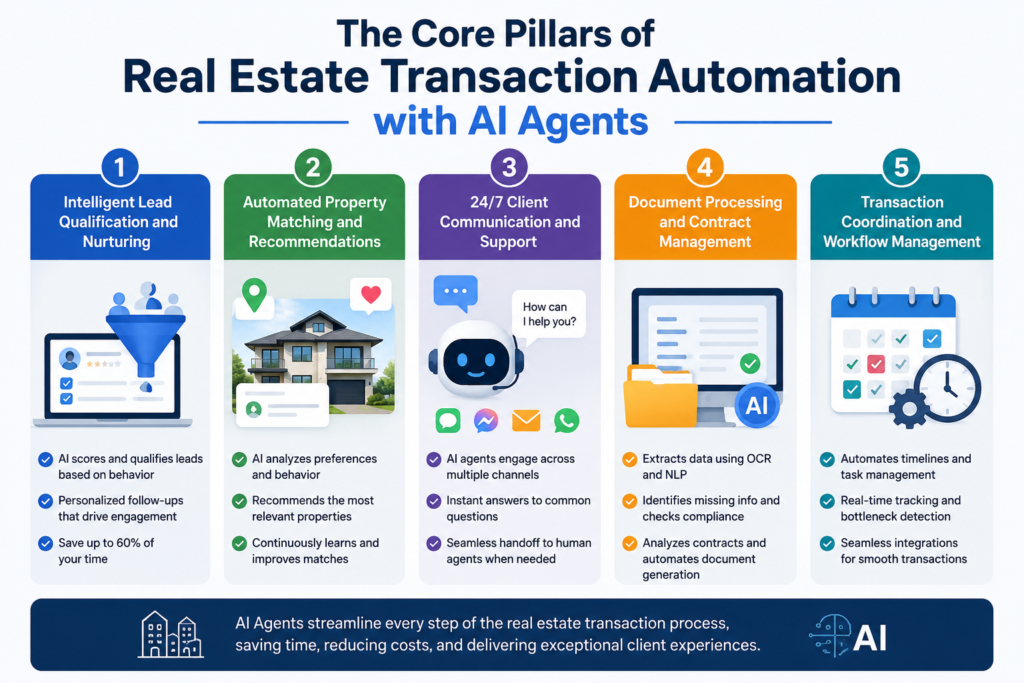
Intelligent Lead Qualification and Nurturing
- We’ve all been there—spending hours chasing leads that go nowhere. AI agents change the game by automatically “scoring” leads based on how they interact with your site.
- If someone spends twenty minutes looking at luxury condos, the AI knows they’re a serious prospect.
- But it doesn’t stop at qualification. These agents also handle lead nurturing automation. They can send personalized follow-ups that actually make sense.
- If a client is obsessed with backyard space, the AI won’t send them a listing for a penthouse; it’ll send them a newly listed suburban home with an acre of land.
- This kind of personalization used to take a whole team; now, it’s done in seconds, saving you up to 60% of your time.
Automated Property Matching and Recommendations
- Finding the perfect property is often a complex puzzle, involving not just explicit preferences but also implicit motivations and lifestyle factors.
- AI agents are adept at this intricate matching process, analyzing hundreds of data points simultaneously.
- They learn from each client interaction, tracking which properties generate interest, which features drive engagement, and how preferences evolve.
- These systems consider explicit criteria like price range and location, alongside subtle signals such as school district quality, proximity to transit, or investment potential.
- The recommendation engine continuously refines its understanding as clients provide feedback, ensuring that future recommendations are increasingly accurate and personalized.
- This responsiveness, often notifying clients of new listings before they hit the broader market, provides a significant competitive advantage.
24/7 Client Communication and Support
- The real estate market never sleeps, and potential buyers often browse listings and have questions outside of traditional business hours.
- AI-powered communication agents ensure that your agency remains responsive around the clock.
- These conversational AI systems handle inquiries across various channels—website chat, social media, SMS, and email—answering common questions about properties, neighborhoods, financing, and services with natural language processing that makes interactions feel genuinely conversational.
- Crucially, these agents are designed to recognize when a conversation requires human expertise.
- Complex negotiation questions or unique situations trigger seamless handoffs to human agents, complete with the full conversation context.
- This hybrid approach ensures clients receive appropriate support while maximizing the efficiency of your human team.
- Agencies utilizing 24/7 AI communication agents report significant increases in qualified engagement and improved client satisfaction [2].
Document Processing and Contract Management
- Real estate transactions are notoriously document-heavy, from initial agreements to final closing papers. A
- I agents are transforming document management from a potential bottleneck into a streamlined, error-resistant process.
- These systems use optical character recognition (OCR) and natural language processing (NLP) to extract information from contracts, inspection reports, loan documents, and disclosure forms [2].
- The AI automatically populates transaction management systems, identifies missing information, flags inconsistencies, and ensures compliance with regulatory requirements.
- Beyond simple data extraction, contract analysis capabilities allow AI agents to review purchase agreements for unusual terms, compare provisions against standard practices, and alert agents to clauses requiring special attention.
- This not only reduces risk but also accelerates review processes that traditionally consumed hours of legal scrutiny. For example, Shriram Properties achieved 99% data extraction accuracy and an 80% validation success rate in invoice processing using AI.
AI agents can create
- personalized contract
- disclosure documents
- Correspondence using approved templates,
- Accurately inserting transaction-specific details.
Transaction Coordination and Workflow Management
- The journey from an accepted offer to a closed deal involves numerous sequential steps, multiple parties, and critical deadlines.
- Missing any element can derail a deal and damage client relationships.
- This is where AI agents provide comprehensive transaction coordination and workflow management, ensuring nothing falls through the cracks.
- These intelligent workflow systems create customized transaction timelines based on property type, financing method, and jurisdictional requirements.
- The AI automatically assigns tasks to relevant parties, sends reminders as deadlines approach, and escalates issues when milestones are missed.
- All stakeholders—agents, clients, lenders, attorneys, and inspectors—receive relevant updates through their preferred communication channels.
Progress monitoring
Progress monitoring happens in real-time, with the AI agent tracking document submissions, inspection completions, financing approvals, and other critical milestones.
When delays occur, the system identifies bottlenecks and suggests corrective actions, proactively preventing last-minute surprises that could jeopardize closings.
Integration with external systems allows AI agents to automatically order title searches, schedule closings, and coordinate final walkthroughs.
This transforms operations from reactive firefighting to proactive management, allowing human agents to focus on relationship-building and strategic activities, ultimately leading to smoother transactions and improved client satisfaction.
Current AI Trends and Industry Insights
AI in real estate is a fundamental shift, not a trend. The market for AI agents is set to explode, growing from $7.84 billion in 2025 to over $52 billion by 2030 [3]. This growth is fueled by the industry’s need for efficiency and the proven results of early adopters.

What’s Next? Emerging Tech on the Horizon
Current tools are just the beginning. We’re already seeing Generative AI drafting contracts and marketing copy, while Predictive Analytics helps agents spot market shifts before they happen.
Looking further out, Blockchain Integration could make escrow services nearly instant through AI-managed smart contracts [4]. We’re also moving toward Agentic AI—systems that don’t just wait for your command but proactively manage workflows. Shriram Properties is already exploring this with their ‘Parivar’ app, which uses AI to provide hyper-personalized updates to clients without an agent having to lift a finger.
The Human Element: Collaboration, Not Replacement
AI isn’t here to replace us; it’s here to help. As Hariharan Subramanian of Shriram Properties puts it, trust in automation builds over time as it consistently delivers results.
By handling the repetitive, data-heavy tasks, AI agents free you up for the parts of the job that require a human touch: empathy, negotiation, and deep relationship building. It’s a partnership where technology handles the precision, and you handle the people.
Why This Matters for Your Business?
If you’re running a real estate business, AI agents aren’t just “cool tech”—they’re a competitive necessity.
Here’s why:
- Efficiency: Automating lead scoring and paperwork means your team can handle more deals without getting burned out.
- Cost Savings: Fewer manual errors and streamlined workflows mean lower overhead. Shriram Properties, for example, saw a 25% cost reduction.
- Better Service: 24/7 responses and personalized property matches keep clients happy and coming back.
- Accuracy: AI doesn’t get tired or overlook a clause in a contract, ensuring you stay compliant and error-free.
- Scalability: You can grow your transaction volume without having to double your staff overnight.
Conclusion:
The real estate industry is undergoing a profound transformation, driven by the power of AI agents. From automating the intricate dance of transaction coordination to providing hyper-personalized client experiences, these intelligent systems are redefining what’s possible.
As AI agents automate real estate business processes, they are not just optimizing existing processes; they are enabling new operating models that prioritize speed, transparency, and client satisfaction. The future of real estate transaction automation is one in which technology and human expertise work hand in hand, creating a more efficient, intelligent, and ultimately more human-centric industry. By embracing these innovations, real estate professionals can navigate the complexities of the modern market with greater confidence, deliver superior service, and unlock unprecedented growth opportunities.