
Introduction
A user submitted an inquiry at 11:30 PM about a dream house, but when the agent finally replied the next morning, the user had already reached out to other agents and scheduled viewings with them. In the current real estate game, where a digital-first mindset rules, missing even a single opportunity could cost you big time.
For years, real estate pros have stuck to handling leads manually—phone calls, emails, spreadsheets, direct follow-ups, you name it. While this works great for building solid client relationships, it often falls flat with today’s buyers who demand instant responses and extra attention. Slow replies, and you’ve lost; they’ll just move on to someone quicker to the draw.
Things are different now for buyers and sellers too—they contact agents through websites, social media, or online listings, any time, day or night. This non-stop influx means keeping up manually is nearly impossible for agents and firms, no matter how seasoned.
That’s where Artificial Intelligence (AI) comes in. With AI, there’s no waiting around—it lets agents connect right away, maintains personal touches, and spots high-quality leads to act on first. Because in this race, being fast, tailored, and reliable? That’s what reels in the deals.
The Real Impact: ROI of AI Lead Nurturing in Real Estate
Regarding lead nurturing and qualification with AI Automation in Real Estate, ROI is not solely about generating inquiries. ROI primarily depends on how well you handle leads—how quickly you engage them, how accurately you qualify them, and how many you convert into appointments and sales. Often, the real game changer isn’t the quantity of leads, but the quality of follow-up and communication.
In real estate, ROI is seen when agents stop losing potential buyers due to delayed responses or missed follow-ups. Instead of manually tracking every inquiry, AI helps prioritize serious prospects and maintain ongoing communication. This helps agents optimize their time and maintain consistent engagement with genuinely interested buyers. Key performance improvements
Key performance improvements
The most noticeable improvement is significantly faster response times; AI answers new queries instantly, even when Hatta isn’t around.
Another advantage is that more appointments get booked. Qualified leads now easily make viewing appointments without any hiccups.
There’s also less lead drop-off because automated follow-ups keep prospects engaged and don’t let them fade away.
Short case-study style examples
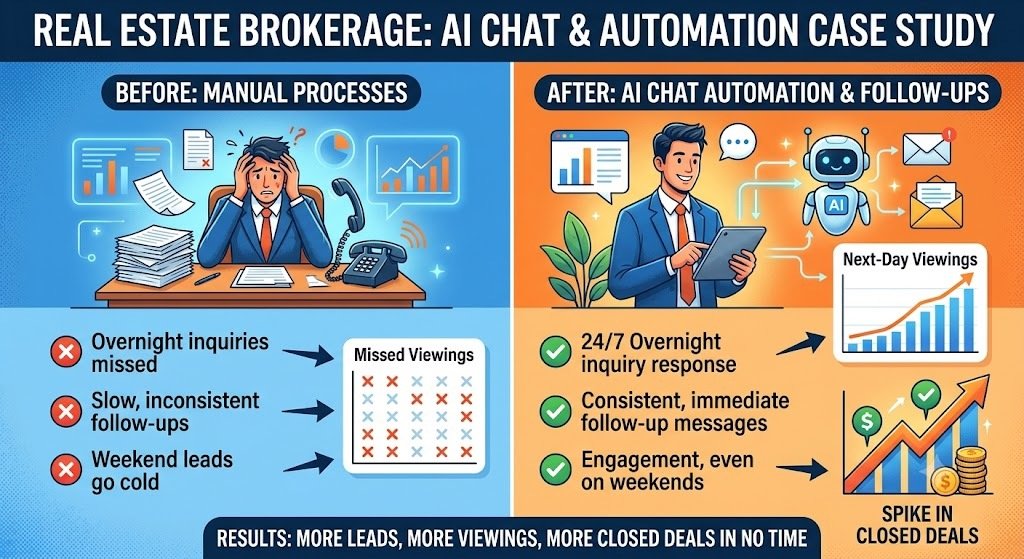
Take a boutique brokerage that uses AI chat automation. They noticed more overnight inquiries turned into next-day viewings, which previously got missed. Another agency improved its game with automated follow-ups, making sure every lead got consistent messages, even during weekends. These little tweaks led to a spike in closed deals in no time.
From Leads to Clients: Step-by-Step AI CRM Integration
Talking about automating lead nurturing and qualification for AI in real estate, the game-changer comes when AI is integrated with your CRM system. This is where disorganized leads transform into well-structured, trackable opportunities. They move seamlessly through the sales pipeline, becoming actual, actionable prospects.
How AI connects with existing CRM systems
CRMs such as HubSpot, Salesforce, and Zoho now have AI integrations or APIs. These AI tools work as an extra layer on top, gathering leads from various places and adding them straight to the CRM.
So nothing falls through the cracks—no website inquiries, listings, or ad responses get missed or held up. Everything gets logged correctly and right away.
Simple integration flow
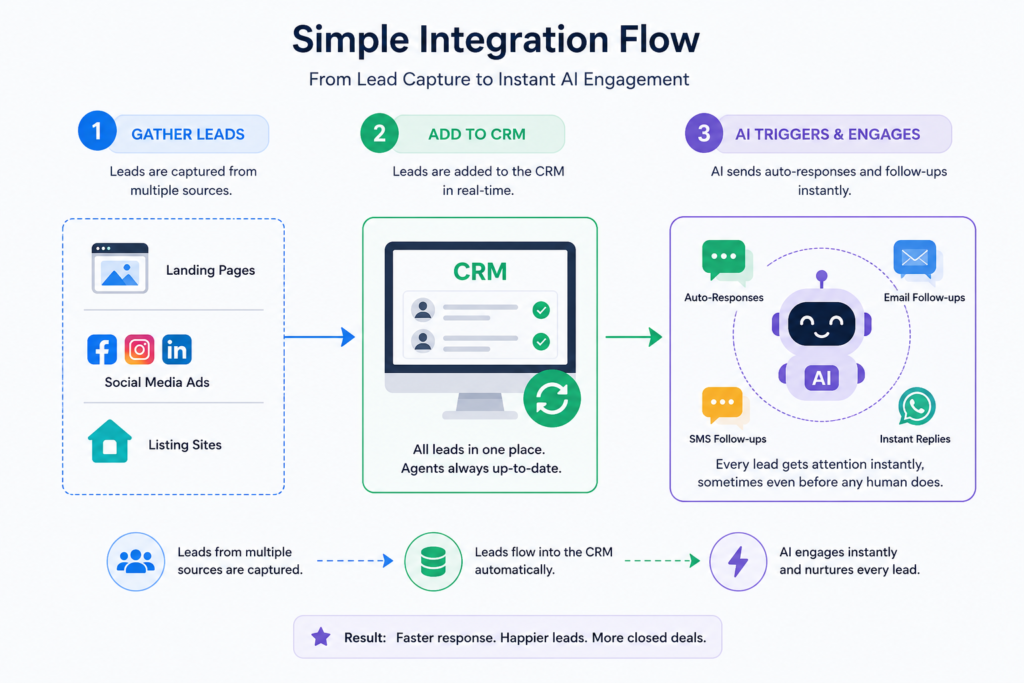
It all begins by gathering leads from different sources, such as landing pages, social media ads, and listing sites. Next, these leads are added to the CRM right away, so agents are always up to date.
Lastly, AI triggers auto-responses and follow-ups, making sure every lead gets attention instantly, sometimes even before any human does.
Lead scoring and tagging
When leads get added to the system, AI steps in to score them by checking how ready each prospect is to convert, looking at things like their actions and interest level.
It sorts these leads too, using tags like “hot buyer,” “rental inquiry,” or “investor.” This makes it way easier for agents to know who to focus on, helping them prioritize their efforts correctly.
Testing and optimizing workflows
After setup, it’s crucial to test the entire workflow. This includes checking response timing, lead routing accuracy, and follow-up sequences. Small adjustments over time improve system performance, making it more efficient and aligned with real buyer behavior.
Ultimately, AI CRM integration isn’t just a technical setup—it’s a practical shift that enables faster responses, better organization, and more consistent client engagement.
Data Privacy & Compliance: Keeping Automation Responsible

By using Automating Lead Nurturing & Qualification for AI Automation in Real Estate, businesses not only need speed and efficiency, but also a lot of responsibility.
Automated messaging helps in providing immediate response to agents and nurturing leads promptly, but if proper compliance is not observed, it can damage customer trust and may even lead to legal issues.
In real estate, relationships and credibility are very important, but it is also very important to follow data privacy rules.
Compliance ensures that every message sent through automation is not only effective but also protected, transparent, and trusted on legal grounds.
Buyers and sellers want to handle their personal information responsibly, and this trust directly impacts conversion rates. This is why key regulations play such an important role.
GDPR protects user data and ensures that proper consent is obtained before any personal information is collected or used.
CCPA gives consumers control over how their data is stored, shared, and deleted.
The TCPA aims to regulate automated calls or messages so that businesses can be prevented from receiving unwanted or intrusive communications. When automation is used, we have to maintain compliance during the period, and we have to follow the best practices of real estate professionals.
- First of all, always use clear opt-ins so that your leads know what type of communication they are signing up for.
- Secondly, by ensuring Strong Data Protection, you can avoid data leaks or unauthorized access.
- Last but not least, transparent messaging policies should be maintained so that the user remains clear as to how or for what purpose their data is being used.
By combining automation with strong privacy practices, real estate businesses can scale their lead nurturing efforts while building long-term trust and maintaining full compliance.
Training AI on Real Estate Data for Smarter Qualification
Generic AI tools are ineffective in handling basic conversions, but sometimes, in property transactions, we may miss important context such as budget signals, buyer’s intent, or location preference.
Why generic AI is not enough in real estate
Real estate is a highly contextual field. Simply sending a message like “interested in property” doesn’t indicate whether a person is a serious buyer or just browsing. Without proper training, AI may provide accurate answers but fail to effectively prioritize leads. This could result in missing important opportunities
How brokers can train AI using real estate data
Brokers can improve AI performance by providing relevant data. This includes property listings, which help AI understand pricing, location, and features. Additionally, past client interactions are important, revealing common questions and Property buying patterns. Buyer and seller behavior patterns, such as page visits or inquiry timing, also help AI better understand intent.
Benefits of custom-trained models
After proper training,
- AI provides more accurate lead scoring,
- It allows agents to focus on high-value prospects.
- It also improves intent detection, meaning the system can differentiate between buyers, casual browsers, and investors.
- Most importantly, it enhances personalization, where responses appear more relevant and human-like, which increases engagement and trust.
Build vs Buy: Off-the-Shelf AI vs Custom AI Agents
In the exploration of Automating Lead Nurturing & Qualification for AI Automation in Real Estate, one of the key decisions is whether to use off-the-shelf AI tools or build a custom AI system. Both options can improve lead management, but they serve different business needs depending on budget, scale, and long-term goals.
Off-the-shelf platforms
Off-the-shelf AI solutions are ready-made tools that can be implemented quickly. They offer quick setup, making them ideal for small teams that want to get started without technical complexity. They also come with a lower upfront cost, which reduces initial investment risk. However, they often provide limited customization, meaning they may not fully adapt to specific workflows or advanced qualification needs in real estate.
Building proprietary AI systems
Custom-built AI systems offer high flexibility, allowing businesses to design workflows based on their exact sales process. They also provide better long-term scalability, making them suitable for growing brokerages handling large lead volumes. The main drawback is a higher initial investment, as development, training, and integration require more time and resources.
Simple cost-benefit comparison
For small real estate teams, off-the-shelf tools are often more practical due to their affordability and ease of use. Mid-sized agencies may benefit from a hybrid approach, starting with ready-made tools and gradually customizing features. Large brokerages, on the other hand, gain more value from building proprietary AI systems, as they need deeper control, better lead segmentation, and advanced automation.
Keeping It Human: Human-in-the-Loop Automation Strategy
It’s important to remember that real estate is still a people-driven business. While AI can handle speed, follow-ups, and qualification, clients still expect human understanding, especially when decisions involve large financial and emotional commitments.

Why full automation can feel “cold” to clients
If every interaction is handled only by AI, the experience can feel impersonal. Buyers may get quick responses, but they often miss the reassurance and trust that comes from speaking with a real agent. In real estate, emotions play a big role, and purely automated communication can sometimes reduce engagement.
Where human agents should stay involved
Human agents should step in at key moments. For high-intent leads, personal interaction helps build trust and close deals faster. During negotiation stages, human judgment is essential for handling pricing discussions and objections. Similarly, for complex inquiries, such as legal or investment-related questions, clients prefer direct expert guidance rather than automated replies.
Blending AI speed with human trust
The best approach is a hybrid model where AI handles speed and structure, while humans provide empathy and decision-making. AI can respond instantly, qualify leads, and schedule follow-ups, while agents focus on meaningful conversations and closing deals. This balance ensures efficiency without losing the personal connection that clients value.
Common Mistakes in AI Lead Automation
Here are common mistakes in AI-lead automation.
- Over-automation leading to robotic or impersonal communication
- Sending too many messages, causing lead fatigue and unsubscribe rates
- Poor or outdated lead scoring models that misclassify high-intent leads
- · Ignoring feedback from sales agents who interact directly with leads
- Lack of continuous optimization and performance monitoring
- Using generic, one-size-fits-all messaging instead of personalization
- Delayed response times due to poorly configured automation workflows
- Not segmenting leads properly based on behavior, intent, or source
Measuring Success Beyond Conversion Rates
When it comes to Automating Lead Nurturing & Qualification for AI Automation in Real Estate, many teams focus only on conversion rates. But that alone doesn’t show the full picture of how well your system is actually performing. To truly understand success, it’s important to look deeper into operational and engagement metrics.
Why conversion rate alone doesn’t tell the full story
Conversion rate only shows final results, not the quality or efficiency of the journey. A system may convert leads but still waste time, delay responses, or overload agents. That’s why relying only on conversions can hide major gaps in performance.
Lead-to-appointment rate
This metric shows how effectively leads are moving from interest to actual meetings. A higher rate means your AI nurturing process is successfully qualifying and engaging the right prospects.
Time-to-first-contact
Speed matters in real estate. This measures how quickly a lead receives the first response. Faster contact increases trust and improves chances of booking appointments.
Agent productivity and time saved
AI automation should reduce manual workload. This metric highlights how much time agents save by focusing only on high-quality, ready-to-convert leads instead of unqualified inquiries.
Channel Consistency Response
Customers will communicate with leads via Email, SMS, and chat. Having your messaging consistent across all channels will make for a more seamless experience, which fosters brand trust.
Collectively, all of the aforementioned metrics provide insight into real business efficiency that goes above and beyond conversions and allows real estate teams to both optimize performance and better the customer experience.
Conclusion
So in real estate, today AI isn’t something replacing humans, it’s something helping humans by streamlining tasks, but the power comes when the automation and perfect personal human interaction are combined. Over-automating loses the trust, fully manual kills growth, and success is when automation, perfectly timed, personally timed communications come together so your real estate business has a smarter, more scalable pipeline that predictably turns prospects into raving lifelong clients.